twitter
facebook twitter tumblr newsletter
Tagged:
Interview
 

Spook’d

The New Inquiry’s Malcolm Harris and The Los Angeles Review of Books’ Evan Kindley talked on Twitter with Spook Magazine’s one-man editorial team Jason Parham about the new publication’s founding, goals, and forthcoming first issue.

Evan Kindley: I’ll start us off. Jason, how long have you been planning Spook? When was it born?

Jason Parham: The idea was born in December. I officially started reaching out to possible contributors in January. There seemed to be a gap, so I thought, foolishly enough, I could fill it. Toni Morrison is famous for saying, “Write the book you want to read.” Spook is born out of that thinking.

Evan: What gap exactly were you perceiving?

Jason: There are a ton of great and important literary journals, The Paris Review, Slake, Harper’s, and so on. But so often writers of color don’t appear within the pages. There are always one or two.  I wanted, in some way, to change that. Don’t get me wrong, Spook is not a terribly original idea. There have been African-American lit journals in the past, The Crisis, Fire!!, Bronx Biannual, and Greg Tate’s Coon Bidness, which came out in 2011. Spook extends this tradition while imagining its own future.

Continue Reading


An Interview with TNI’s Creative Director Imp Kerr in The Huffington Post

March 2, 2012

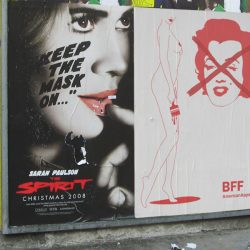
Imp Kerr is an enigmatic artist and graphic designer based in New York. HuffPost Arts first heard about her in 2007, when a series of racy faux-American Apparel images went viral. Now Ms. Kerr is employed by The New Inquiry, and regularly blogs for the online magazine in the column, “Shines Like Gold.”

Since Imp Kerr’s identity remains something of a mystery, we were only allowed to interview her via e-mail, so we’re assuming she’s an 87-year-old man, even though she claims she was born in a place called “Sweden.” Her answers to our questions are below.

HuffPost Arts: When you began your ad spoof series, why did you single out American Apparel in particular?

IK: I guess it was more stimulating (and easier) to pick up a company with a subversive and raunchy touch, than say Abercrombie & Fitch and its glabrous fops, or Gap. I also deliberately profited from the fact that AA was all over the place, in the news and in the streets, all the wows and the eews, and I basically surfed on that ambivalent popularity, putting AA logo on my design and using it to call attention.

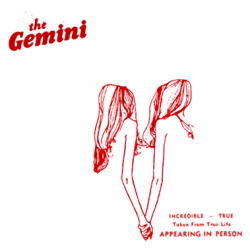
It looked like a game between AA and me (What could I do with this brand? How can I vampirize their topicality?), but my series was not really about AA, and contrary to what some people thought, it was not to denounce AA. I am not a feminist, I am not militant… I just like to create scenes and fictions, small worlds, situations that don’t exist. And if possible, I make these situations complex, like if you look into them you should find more than you expect, but at the same time I care about making them minimal and appealing in appearance.

There’re several ways to look at the AA series. One is that I simply drew an interlacement of red lines on a white background, which was just lines if you zoomed in, and I was adding the AA logo and a slogan, and I was Photoshopping that design into a street scene. I made about 20 images like that, and posted them along one year. It’s a truism but twenty similar images have a stronger effect than one image. So at the end it was a campaign, a story, a small world, subtle enough to confuse and raise questions. From a nude, one spoof ad, it became a hoax and a plural commentary on nudity, advertising, street art, Internet credulity, limits (in representation, judgment, etc), truth and fiction. I was impressed when Hamilton Nolan from Gawker, who I never met before, wrote that the ads were shouting “What is art? What is porn? What is advertising?” These red lines were about nudity (like in “nude is a classical theme in Art History”) and about advertising ripping off art like art ripped off advertising (zzzzz), but above all, they were an aperture to many questions, first because there were twenty of them.

Read the full interview here.


No Kings of New York

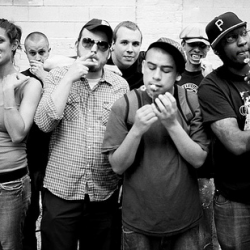
I sat down to talk with the seven members of the Doomtree Collective a few minutes before their show at The Gramercy Theatre. Originally planned for the Bowery Ballroom, a burst pipe forced the performance to the new location, but the five lyricists (Cecil Otter, Dessa, Mike Mictlan, P.O.S., Sims) and two producers (Lazer Beak, Paper Tiger) were all relaxed. Touring in support of No Kings, their first collective album in over three years, Doomtree added another 2011 release with an album of Fugazi/Wu-Tang Clan mashups. When they’re all in the same room, the group has a Scooby-Doo quality. With the kind of statistically improbable character variety found only on television serials, Doomtree seems equally equipped to produce genre-expanding music and solve paranormal crime. To my knowledge they only do one of the two on a regular basis.

Continue Reading
 

The Madman’s Interpreters

By

Raymond Roussel (1877-1933) was an avant-garde French poet, playwright, and novelist. Born into a wealthy family, he devoted his life and fortune to crafting and publishing eccentric works of art that he thought would bring him universal acclaim. Alas, they only managed to baffle a few members of the French public and to be ignored by the rest. After his death, by suicide in Palermo, he published How I Wrote Certain of My Books, the skeleton key for his novels Locus Solus and Impressions of Africa and some of his other writings. There he explains that he generated his texts with an elaborate method known as the “procédé,” based on the use of puns. Though his writing was embraced by the surrealists, Roussel’s work was virtually unknown during his lifetime. He remains an obscure figure to this day, but his influence on the 20th century French and American avant-garde is unparalleled. Besides the surrealists, his admirers include Salvador Dali and Marcel Duchamp, Michel Foucault and Alain Robbe-Grillet, Raymond Queneau and Georges Perec, John Ashbery and Kenneth Koch.

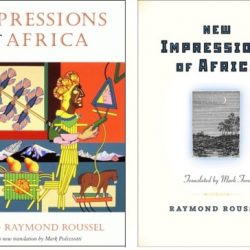
This year, two of his books have appeared in English. The first, Impressions of Africa, has been translated by Mark Polizzotti, author of books on André Breton, the Comte de Lautréamont, and Bob Dylan. Polizzotti is currently the Editor in Chief of the publishing wing of the Metropolitan Museum of Art. The second, New Impressions of Africa, has been translated by Mark Ford, author of three collections of poetry and of Raymond Roussel and the Republic of Dreams, a biography. Ford currently teaches in the Department of English Language and Literature at University College London.

In the following double interview, Polizzotti and Ford discuss the life and work of one of France’s strangest writers with TNI.

Continue Reading
 

The Art of the Interview: Frederic Tuten

By

John Haskell: : The thing about that was, you were almost destined to write Tintin. But hadn’t you already written…

Frederic Tuten: My first book was The Adventures of Mao on the Long March. Roy Lichtenstein did the cover for me. Roy was really the reason it got published because no one wanted to take it. Nobody, nobody, would take the book. They all said, “This is not a novel.” Time and again, rejections would say: “This is not a novel, why are you sending me this?” And finally I said, “OK, I’ll publish it myself.” I don’t know where I got the idea to go to Gibraltar and print it there. And I asked Roy if he would make the book jacket for me. I left him the manuscript and after a few days he phoned and said he would do it. I don’t know why I even had the nerve to ask him. And then this small publisher said, “Well, if Roy Lichtenstein will do a special edition with a lithograph we’ll publish a trade edition,” and Roy agreed. I’ll show it to you one day. An image of young Mao Zedong with a kind of cloud bursting behind him. It’s very beautiful. That was two years before Andy Warhol made his first Mao.

Continue Reading