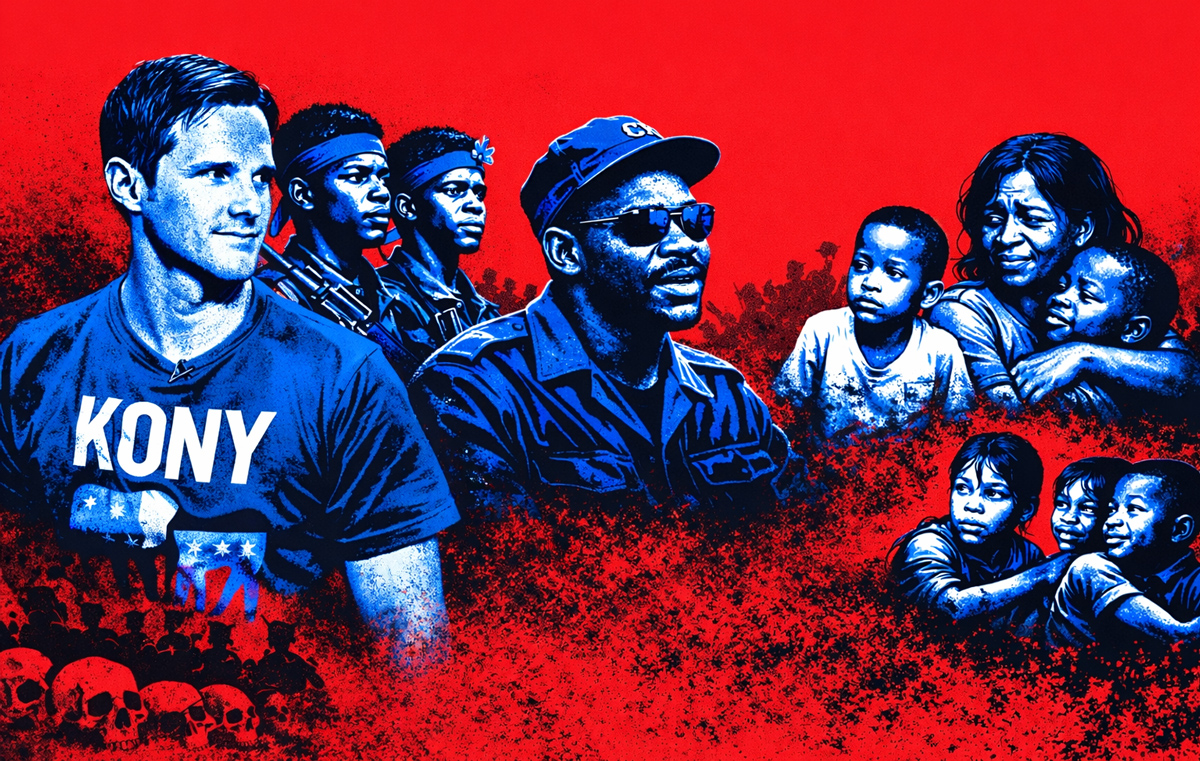
On the second day of January 1985, the spirit took hold of Alice. She went out to heal the sick, and heal the sick she did. But sickness multiplied faster still, for Uganda was wracked with civil war. Within the year, the government would fall. Acholi soldiers who had killed for the ousted regime fled back north only to become strangers in their homes. The new president, Museveni, called them primitives, criminals, murderers; his occupying army tortured, raped, and killed before demanding their victims disarm. God knew it was useless to heal the sick today only for them to be gunned down tomorrow. In August 1986, the holy spirit told Alice to go to war.
The men who joined her were the old soldiers of a vanquished state, shunned by their elders and haunted by ghosts. They purified themselves to purify the country. To forge a new nation, they declared a new kind of war. Drinking, looting, and adultery were forbidden. They were to treat their prisoners better even than their own. They stood tall on the battlefield, singing hymns as gunfire thundered around them.
Alice Lakwena’s tactics were incomprehensible and victorious regardless. Museveni’s troops dropped their arms in wonder and fled in fear. By year's end, the Holy Spirit Mobile Forces numbered 18,000 soldiers marching towards the capital of Kampala. “Hath not God made foolish,” the Apostle Paul queried the wayward church in Corinth, “the wisdom of the world?”
The Ugandan government forces organized loyalist civilian councils to stem the rising insurgency. As a result, the Holy Spirit Mobile Forces shed non-combatant blood. This sin, Alice’s spirit proclaimed, was unforgivable. And so it was that in November 1987, the Holy Spirit Mobile Forces were defeated by the Ugandan army. Alice died in a Kenyan refugee camp, abandoned by her spirit and soldiers alike.
The mantle that Alice lost was taken up by a man said to be her cousin. His fighters likewise purified themselves to battle for a world where angels reigned and soldiers were no more. Holy Spirit Tactics were abandoned for classical guerrilla warfare. The prohibitions on kidnapping civilians for labor or sex were loosened. But the Ugandan government, too, raped and killed, so the rebels still counted many supporters and sympathizers.
By 1990, his forces were the only opposition remaining in northern Uganda. With the Ugandan state fed by Western capital and the rebels supported by the rival Sudanese regime, both sides were freed of the imperative to secure popular legitimacy in order to prosecute the war. No longer did either army ask the people of northern Uganda for loyalty, belief, or legitimation. They only demanded more labor, blood, and corpses. On one side, the concentration camps and martial law of the state. On the other, Alice’s cousin, Joseph Kony, and his Lord’s Resistance Army.
“Nothing is more powerful than an idea whose time has come,” declares the black-and-white title card. Simulated film grain and radio static resolves to a shot of the Earth spinning above the buzzing drone of Nine Inch Nails’ “02 Ghosts 1.” Cut to nighttime, the glowing threads of electrification knitting together continents. We’re told that the number of Facebook users today is greater than the global population two centuries ago. We’re told that this interconnectedness reminds us what we have in common. We’re told that the next 27 minutes spent watching this video are an experiment, but that for it to work we must pay attention.
We are watching the most viral video of all time. Our narrator is Jason Russell, the “Abercrombie & Fitch version of Jesus Christ” and co-founder of nonprofit Invisible Children. We see his wife give birth to his son, Gavin. We learn, with Gavin, about Jason’s trip to Uganda a decade before and his ongoing mission to end the reign of terror created by the Lord’s Resistance Army and its crazed leader, Joseph Kony. We are told that in this year, 2012, we will change human history. United by social media, we global citizens will demand that our leaders put an end to his atrocities: intervening not for political gain or brute self-interest because of the humanity we share with Kony’s victims.
“Arresting Joseph Kony will prove that the world we live in has new rules, that the technology that has brought our planet together is allowing us to respond to the problems of our friends,” proclaims Jason. “We are not just studying human history, we are shaping it.” In his grave, Marx wept.
Kony 2012’s major goal was to “make Joseph Kony a household name.” It succeeded, immediately. A million people watched Kony 2012 the day it went live. By week’s end, a full half of the U.S. population had heard of it. 11 million people shared it on Facebook. It was recommended by Obama, Oprah, and Justin Bieber alike. And then, just over a week after it appeared, the Kony 2012 campaign collapsed under the weight of its own pretensions and contradictions.
But for a few glorious days, Kony 2012 was victorious, a fact all the more remarkable given its context. When Kony 2012 was released, the US was just months from its long-awaited supposed military withdrawal from Iraq. The president who ran on ending the War on Terror was about to be re-elected for a second term. The chest-thumping triumphalist aggression of the Bush years had already faded, presaging the election of Trump as the most dovish Republican president in a century. Biden would send tens of billions of dollars of cash and battle tanks and cluster bombs to what he called Ukraine's fight “between democracy and autocracy, between sovereignty and subjugation”—all while refusing to commit a single U.S. soldier, who were to be stationed only as close as NATO treaty obligations require. Aborting any military strategy that might risk American casualties stands as one of the few remaining points of bipartisan consensus, for in the second decade of the twenty-first century in the heart of the empire, the doves have won. The last two decades are the story of the imperial electorate gradually losing its nerve.
Except for the second week of March 2012, when Republicans and Democrats, celebrities and civilians, people across the nation—but especially the young and online, the very demographic that would re-elect Obama that November—clamored for war. They demanded intervention, deployment, blood. They cried out for American boots on East African ground. Fed up with the war said to free us from terror, they insisted on a new one.
It might seem harsh to say that Kony 2012 infantilizes its audience, but it’s worth noting that we’re introduced to the film’s antagonist through a conversation between Russell and his elementary school-aged son, Gavin. Gavin knows that his father “stops the bad guys from being mean,” but, like the audience, does not yet know about Joseph Kony. The only reference for bad guys that Gavin can offer is the “Star Wars people,” until Russell reveals that the Vader of this story is Joseph Kony. Kony’s legitimately horrifying offenses are explained, if in brief: slaughter of civilians, child abductions, sexual slavery. These abominations, it bears repeating, are true, the naked brutality of an insurgent war-machine shod of any pretense to popular legitimacy or democratic support. What Kony 2012 misses is any great specificity about what, precisely, is to be done in response.
This conundrum might have been resolved more satisfactorily had Russell ever seen Kevin Smith’s 1994 stoner comedy Clerks, in which eponymous convenience store clerk Randal disputes the morality of blowing up the second Death Star in Return of the Jedi. The first Death Star was a legitimate military target, a fully operational military base staffed by uniformed soldiers when Luke Skywalker destroys it at the end of the original film. But the second Death Star was still under construction, Randal explains, so untold numbers of innocent contractors—”plumbers, aluminum siders, roofers” and the like—were inevitably vaporized as collateral damage.
“Speaking as a roofer myself,” a customer interjects, “I can say that a roofer’s personal politics come heavily into play when choosing jobs.” Perhaps a contractor is not so blameless when the contract in question involves putting finishing touches on a moon-sized laser platform. “Any contractor willing to work on that Death Star knew the risks,” the roofer continues. “If they were killed, it was their own fault.” Though they were not enlisted, the second Death Star’s roofers must have known the moral and physical hazards of working on a planet-obliterating machine amidst an active rebel insurgency—and freely chosen to take the job regardless.
What complicates Russell’s crusade against his real-life Vader is that his adversaries neither enlisted in nor worked as contractors for Kony’s army but were largely forcibly impressed as unwilling child soldiers, which is the very point of the anti-Kony campaign. Should Kony 2012 succeed, Kony would not be whisked away to the International Criminal Court through the force of public opinion but at the ends of American-provided rifles. This, presumably, would occur after the military defeat of the Lord’s Resistance Army, which would, unavoidably, involve the slaughter of a number of the child soldiers who composed it. Kony 2012 studiously avoids following this thread, because concerning the question of repressing the Lord’s Resistance Army, the devil would be in the details.
The Lord’s Resistance Army of Kony 2012 has no objectives, no program, no mission save for the perverse promotion of brutality. “As if Kony’s crimes aren’t bad enough, he is not fighting for any cause but only to maintain his power,” Jason Russell tells us. “He is not supported by anyone, and he has repeatedly used peace talks to rearm and murder again and again.”
Museveni’s regime concurred, painting not only the LRA but northern Ugandans writ large as barbaric primitives. Yet the LRA conducted informational campaigns, released secular political manifestos, and called for a ceasefire during the 1996 presidential elections, in which they supported opposition candidate Paul Ssemogerere.
As Lord’s Resistance Army/Movement Manifesto declares:
LRA/M recognize the importance of the World Bank and IMF Structural Adjustment Programs. However, we also recognize that these programs have concentrated on achieving low inflation and deregulating markets to the exclusion of other considerations. The resulting deflationary pressures have undermined prospects for economic recovery, compounding inequalities, undermining the position of women, and failing to protect poor people’s access to health and education services.
The turning point for the Lord’s Resistance Army came when the World Bank offered the Ugandan regime a generous loan conditional on the pacification of the rebellious north. The region was cordoned off and dissidents jailed, with residents corralled into concentration camps and forced to take up arms against the rebels. Drained of the sea of popular support, Joseph Kony’s guerrillas were doomed to spin themselves out.
Except, that is, for the generous support of the government of Sudan. Uganda supported the separatists of the Sudan People’s Liberation Army in that country’s south. Sudan avenged this subversion in kind by providing the LRA training facilities, military bases, and medical assistance. This entirely obviated any motivation for the LRA to retain civilian support. Thereafter, the LRA need only rule through escalating brutality, with mass kidnappings enlarging its ranks to allow it to fight the SPLA and the Ugandan army simultaneously.
Sudanese support only waned after the LRA was listed on the USA PATRIOT Act’s Terrorist Exclusion List, with the Sudanese state pressured to allow a thousands-strong military incursion by Ugandan forces accompanied by US logistical support in 2002. By this time, the transformation of Acholi northern Uganda into a gulag archipelago was complete. In early 2003, concentration camps held one and a half million people, whose needs from food to sanitation were seen to not by their own government but exclusively by international humanitarian organizations. At the end of the year, the International Criminal Court took up the situation in northern Uganda as its first major case. The only warrants to be issued would be for LRA commanders, not the Ugandan leaders who had overseen the indiscriminate slaughter of Acholi civilians as early as the late 1980s and whose concentration camps would lead to an estimated 1,000 civilian casualties from overcrowding and disease each week.
As it prepares to crush an insurgency, the intermediate goal of the counterinsurgent state is to strip its opponent of the mechanisms of political legitimation: to reduce a self-described struggle for liberation or justice or God to mere brigandage and self-serving violence, thereby securely isolating the militants from popular legitimacy. This is not to excuse the horrors committed by Kony and his child army, nor to impute that such atrocities were the secret plan of Ugandan state elites. But insofar as Uganda’s rulers were rational actors, they must have hoped that the insurgency they fought would reduce itself to just such barbarities. As an article in the US Army War College’s Parameters puts it, “When rebels use brutal tactics against civilians, counterinsurgents should capitalize on the opportunity.” The brutality of the LRA against its original constituency constituted a strategic victory for the Ugandan state. The insurgents were so cut off from popular support that they could only secure cooperation through mass kidnappings and disfiguring violence.
And as far as excusing horrors went, the nations of the Free World were exceptionally generous whereas the Ugandan one-party state was concerned. A partner to US efforts to combat “Islamic extremism” by destabilizing Sudan using the SPLA and a willing accomplice to IMF and World Bank neoliberal reforms, Museveni was looked upon especially favorably by international donors in the United States, United Kingdom, and France. In 2005, opposition presidential candidate Kizza Besigye was arrested for alleged collusion with the LRA. “If anything, it is local Acholi soldiers causing the problems. It’s the cultural background of the people here: they are very violent. It’s genetic,” said Major General James Kazini, a top military advisor to Museveni.
Museveni was considered a reliable ally in the War on Terror, with the US far more inclined to “decapitate” the LRA than support negotiations. It was not until 2006 that the Ugandan government and the LRA signed an agreement for the cessation of hostilities, which the LRA had long insisted was a precondition for peace talks. When Kony 2012 came out over half a decade later, the LRA numbered just hundreds and had not been in Uganda for the greater part of a decade. By that time, the conflict in northern Uganda was attracting over a billion dollars of humanitarian aid and development assistance a year. The region was awash with foreign aid workers administering to a population suffering not from war but the deplorable conditions of the camps still housing a million internally displaced people. The forces of order had prevailed. So too had HIV, hepatitis, and endemic child prostitution.
Kony 2012 does not concern itself with such trivialities. The film is exacting in recounting the truly abhorrent crimes which arm its moral argument for insisting that we “get” Kony and bring him to justice, but remains breathtakingly imprecise as to what “getting” him would entail. At the time of filming, the quest to “get” Kony involved the effective imprisonment of a million civilians. This, presumably, was an acceptable cost. Perhaps the Ugandan support of insurgent forces in Sudan was a necessary burden as well. A photo circulated of Jason Russell and two of Invisible Children’s other co-founders posing with coiffed hair, two semi-automatic rifles, and a rocket-propelled grenade launcher with militants of the Sudan People’s Liberation Army.
On the fifteenth day of March 2012, precisely ten days after his film captivated the planet, the spirit took Jason Russell. Perhaps nothing heaven-sent, though a force extraordinary enough to throw the best-laid plans of man into confusion. For on that Friday morning, a man who had just accomplished his life’s work was running half-naked into traffic outside his San Diego home, shouting vulgarities, banging on cars. The video of the affair went viral, as well. Kony 2012 featured Russell as the hero of its narrative as unambiguously as Kony was its villain. The campaign could not survive without Jason Russell. His public breakdown killed the #Kony2012 campaign just a week and a half after it began.
A decade later, Russell’s Invisible Children is soldiering on. Joseph Kony and the remnants of the Lord’s Resistance Army are, too. Neither pose much of a threat to anyone. But the film’s long shadow persists.
Six days after Jason Russell’s public meltdown torpedoed #Kony2012, Israeli human rights organization B’Tselem reported on the sharp rise in casualties in the Gaza Strip the previous year: 105 fatalities in 2011, of which it confirmed 37 as non-combatants. In October 2023, the Israeli assault on Gaza would multiply that number a hundred-fold. Churches, hospitals, apartment buildings, schools: all converted to nurseries fostering thousands of corpses. Those who pulled the trigger claimed responsibility for the carnage lay not with them but with their victims, those who had coerced them into leveling their cities. “We will perhaps in time be able to forgive the Arabs for killing our sons,” Israeli Prime Minister Golda Meir had said half a century before, “but it will be harder for us to forgive them for having forced us to kill their sons.”
Countless Palestinian casualties are framed as immaterial to the real story as the Acholi concentration camps were to the narrative of Kony 2012. The leering atrocity footage marshalled to support the ensuing US-Israeli war of elimination follows the Kony 2012 script exactly: a slow zoom in on deviance, a sizzle reel of cartoonish villainy, a quick jump cut away from the gory details of the state’s catastrophic response.
We are living in the afterlife of the film that perfected a new model of political propaganda. Kony 2012 pioneered a digital-native mode of psychological warfare, one designed to galvanize a war-weary electorate against foreign insurgencies cropping up during the twilight of American hegemony. Screams without context, horrors without meaning, bombings and starvation and retribution without end.
Kony 2012 may not have succeeded. Tragically, it prevailed.