<?xml version="1.0" encoding="UTF-8"?>
<rss version="2.0"
	xmlns:content="http://purl.org/rss/1.0/modules/content/"
	xmlns:wfw="http://wellformedweb.org/CommentAPI/"
	xmlns:dc="http://purl.org/dc/elements/1.1/"
	xmlns:atom="http://www.w3.org/2005/Atom"
	xmlns:sy="http://purl.org/rss/1.0/modules/syndication/"
	xmlns:slash="http://purl.org/rss/1.0/modules/slash/"
	>

<channel>
	<title>The New Inquiry &#187; Ben Gabriel</title>
	<atom:link href="http://thenewinquiry.com/author/bgabriel/feed/" rel="self" type="application/rss+xml" />
	<link>http://thenewinquiry.com</link>
	<description></description>
	<lastBuildDate>Sat, 18 May 2013 22:22:52 +0000</lastBuildDate>
	<language>en</language>
	<sy:updatePeriod>hourly</sy:updatePeriod>
	<sy:updateFrequency>1</sy:updateFrequency>
	<generator>http://wordpress.org/?v=3.3.1</generator>
		<item>
		<title>Miéville&#8217;s Anticlimaxes</title>
		<link>http://thenewinquiry.com/essays/mievilles-anticlimaxes/</link>
		<comments>http://thenewinquiry.com/essays/mievilles-anticlimaxes/#comments</comments>
		<pubDate>Wed, 19 Sep 2012 14:36:23 +0000</pubDate>
		<dc:creator>Ben Gabriel</dc:creator>
		
		<guid isPermaLink="false">http://thenewinquiry.com/?post_type=essays&#038;p=24902</guid>
		<description><![CDATA[Miéville is less interested in characters and plots than genre itself, which becomes the main character of his novels]]></description>
			<content:encoded><![CDATA[<p><img class="alignnone size-full wp-image-25116" title="houseind-towel" src="http://thenewinquiry.com/wp-content/uploads/2012/09/houseind-towel.jpg" alt="" width="383" height="383" /></p>
<p>Consistently praised for his imaginative world building and florid prose, China Miéville is one of the most lauded writers working in genre fiction. However, the praise stops short — along with readers — at one crucial aspect of almost every novel he&#8217;s ever written: the ending. The narrative climax of any given Miéville novel is almost identical to any other of his disappointing endings: Just when it seems about to boil over, he suddenly cuts the heat and says, Look, it&#8217;s just water.<br />
</p>
<p align="left">Sometimes, the reveal is that the all-powerful magical weapon referred to throughout the book is actually a series of legislative reforms, or a police procedural that ends with the revelation that there is no conspiracy, or even a villain really, just politicians acting as they must. Other times Miéville&#8217;s endings have enough wit and ingenuity to not seem as pedantic as that, but whether or not they ultimately &#8220;work&#8221; for an individual reader, his persistent anticlimaxes speak to the ways in which he intervenes not just in the genre he is explicitly working in (science fiction, fantasy, steampunk, salvagepunk, detective procedural, or whatever else) but also in the novel itself as a genre.</p>
<p align="left">In the realm of genre fiction, technocratic determinism or idealism generally reign. But what Miéville does, which tends very reliably to undercut the narrative of his novels right as they are most engaging, is something I will call fantastical materialism. It is distinct from both the idealism of high fantasy, in which the magical is a material expression of the conceptual (the Dungeons &amp; Dragons paladin or cleric class, whose spell-casting abilities are basically reliant on successfully praying to their God of Whatever Concept, are a particularly striking literalization of this trope) and the technocratic realism of most science fiction, in which social relations are deterministically produced by technology and its related commodities. This is visible in the puerile Kurzweilian fantasy (and hideous neologism) of <a href="%22_blank%22">singularitarianism</a>. <span id="more-24902"></span></p>
<p align="left">Fantastical materialism treats fantastical tropes as technologies themselves. That is, it takes the <em>stuff</em> of genre, those metonymic objects capable of signifying a whole genre simply by their presence and upholds the dialectical tension between the signification and the stuff. The way these specific overdetermined items, by their simple presence, interpolate the text into the feedback loop of genre is acknowledged simultaneously with the way this same mystification is revealed as bad faith.</p>
<p align="left">Perhaps the strongest example in Miéville comes from <em>The Scar,</em> in its depiction of encounters with the <em>grindylow.</em> Coded throughout the novel as the ferocious, mysterious other, they chase the floating pirate city on which the novel takes place, presumably trying to recover a stolen icon that confers the power to refract space, to steal into rooms through the corners of walls and such. This &#8220;fierce natives attempt to recover their fetish object&#8221; trope becomes fantastical materialism when Bellis, the main character, attempts to return the object to the <em>grindylow</em> and they dash it away. It turns out that they have tracked the icon&#8217;s thief to the dangerous edge of the sea not to recover the magical trinket, despite its awesome power, but instead because the thief is also a cartographer and has drawn maps of potential trade routes that will lead to the hostile colonization of their home. The magical totem is therefore not devalued as such — it remains an incredibly powerful and dangerous magic to the humans who stole it — but it is contextualized. By foregrounding the material interests (land) of the novel&#8217;s most fetishized characters, this &#8220;climax&#8221; give precedence to the material reality of the fantasy, to its objects both within their universe and in their function as generic signposts. The idealization that&#8217;s often implicit in allegory is undercut.</p>
<p align="left">No matter how potent the trope Miéville plays with — and the essentialized other is certainly a potent trope in the fantasy genre — he maintains a materialist approach to both their generic qualities (how they overdetermine) and their narrative qualities (how they function within the fictional universe). Miéville’s worlds do not revolve around the way in which they are different from our own, a trap that the vast majority of speculative fiction falls into, but have coherent motivation for their own internal structure. Miéville’s apparent disinterest in the specifically fantastical aspects of his works in the end thus actually serves to bolster their intended impact. Instead of fetishizing the fantastical, it is made as material as all other things. The fantastical elements are never reduced to convenient loopholes or boring sinkholes of extra-narrative explication. By not being idealized, they are provided the space to be used as something other than just props in yet another liberal humanist fantasy of emerging (heroic) interiority.</p>
<p align="left">The ending of Miéville&#8217;s most recent novel, <em>Railsea,</em> ratchets up the fantastical materialism further. Borrowing heavily from <em>Moby Dick — </em>though <em><em>Railsea</em> </em>is perhaps more accurately described as a parody of the secondary literature on Moby Dick than the novel itself<em> —</em> the adventure on Miéville’s railsea is initially framed as the hunt for a giant mole or “moldywarpe” called Mocker-Jack, who forced Captain Abacat Naphi to have a cyborg arm installed. Whereas <em>Moby Dick </em>depicts Ahab’s pursuit of the whale as an obsession, Miéville calls the relation between his captains and beasts <em>philosophies</em>, and every moling captain with the good fortune of having been delimbed by an enormous beast with a distinctive feature (Mocker-Jack is, for instance, &#8220;ivory,&#8221; or &#8220;old-tooth-colored,&#8221; or &#8220;yellow,&#8221;) has one. Both a project and an implicit set of assumptions, a philosophy, in <em>Railsea</em>&#8216;s terms, is something simultaneously detached and ordinary — the exact antonyms of obsession. The implication being, of course, that the beast and the quest for it are far from the exceptional preserve of the individual; they are the very set of implicit assumptions and projected goals that form the structure of civilization. In <em>Railsea,</em> there is even a museum dedicated to captains who have successfully dispatched their philosophies — a testament to Miéville &#8216;s materialist disposition.</p>
<p align="left">The novel’s organization draws on two tropes that are central to the Western canon, those novels that are supposedly beyond genre, and redeploys them in a distinctively generic and fantastical-materialist way. The first of these is the railroad, the relic that promised unidirectional, tracked progress. With belching smokestack over burning headlamp, the train presses on inexorably. Miéville transforms railroads into the railsea, a clusterfuck of switches and turnouts. Had Anna Karenina made her frantic leap in Miéville’s world, that book would have ended with a scraped knee, an annoyed train, and her possibly being devoured by a pack of carnivorous naked mole rats from beneath the earth.</p>
<p align="left">The second trope is the beast, the radically inhuman being whose blasphemous existence provides the external counterpoint against which the individual can constitute himself. As old as Grendel in the English literary tradition, such beasts figure the threat of the destabilization of the order imposed by civilization. The beast is a structural necessity in any literary attempt to allegorize the production of interiority, functioning as a stand-in for the outside (beastly nature) against which the struggle to develop the inside (the product of the civilizing process) must posit itself.</p>
<p align="left">Without this dialectical tension, the individual may be conscious but never truly self-conscious. Only with the introduction of this narrative can interiority be conceptualized, along with its metonymic counterparts like honor, morality, and individuality. Thus, Mocker-Jack, <em>Railsea</em>&#8216;s beast, whose name itself even signifies that this beast is a troubling presence within this system. Because in <em>Railsea</em> the beast is really just that, a monstrous being outside the civilized world who has no stake in it, despite its stake in him. When it is revealed that his only significant linkage — the act of violence that tore off Captain Naphi&#8217;s arm, has been a sham all along (the cyborg arm is only a shell containing her perfectly functioning limb), the outside that provides the condition of possibility for the inside is also delinked, and the dialectical structure of the self is unveiled as nothing more than a tired allegory.</p>
<p align="left">The ending of the novel takes place in a fabled place called Heaven, the rumored end of the railsea. With Mocker-Jack slain, Sham, who had been on the hunt with Naphi, follows the final rail over a massive trestle to the place where the railsea ends. The terminus has no tracks looping back on themselves and no wyes; it has only a machine set up to push trains onto the track. This is the end as the beginning, but without the holistic circle. The two privileged points of nonnarrative materiality, a book’s front and back cover, are revealed to be but one simple system for shoving things back into the world.</p>
<p align="left">The novel climaxes not with a fancy theological tiff but a very material explanation of the world it inhabits, down to how it was financed. <em>Railsea</em>’s anticlimax finds the terminus of Heaven populated with waiting feral bureaucrats, the descendants of the descendants of the crazed railroad tycoons who frenziedly built the railsea in a rash of spending spurred by capitalist competition — an event remembered as the “godsquabble.” These faithful bureaucrats have been keeping records of the costs of the railsea, and nearly kill Sham when he reveals that he hasn&#8217;t come to pay the tab. The mythological origins of the railsea within the text are revealed as an allegory that, no matter how fanciful the world is, palls before the ultimate material explanation.</p>
<p align="left">The godsquabble’s collapse from being a mythological to an allegorical explanation is prefigured in the novel, as one of the Shroake twins offers the material explanation long before it is confirmed. In this way, Miéville stays consistent with his tendency to deny allegory in favor of polysemy, particularly in the field of his monsters — what he has referred to as teratology. By applying teratology, the study of abnormalities, to fiction, Miéville privileges the impulse to taxonomy over the impulse to syncretism that most &#8220;literary&#8221; reading practices engage in. A monster like Mocker-Jack may share attributes with other literary monsters, and it would certainly be possible to syncretically reduce him to an allegory by cutting him down to his resemblance with other storied beasts in order to slot him into a prepackaged narrative about how his specificities correspond with some universalizable ideal. Fantastical materialism, however, insists that any monster goes beyond this eidetic reading, and so a classificatory system must focus on the specificities of any monster as its irreducible component and proceed from there. Thus for Miéville, teratology and taxonomy supplant allegory.</p>
<p align="left">Miéville&#8217;s embrace of classification is the most appreciable way — excepting, perhaps, the tentacles — that he draws on and exceeds H.P. Lovecraft. Lovecraft&#8217;s misanthropy (as evidenced most explicitly in his racism) ties him dialectically to the specifically novelistic humanist narrative that makes the human an exceptional animal via its interiority and to a reliance on the novelistic impulse of centering the work on a character&#8217;s interiority to the point that in “The Mound,” when describing a Native American ghost story as experienced by a 16th century Spaniard, he has to fabricate a frame in which a white American ethnologist can tell us the story and experience all the terror.</p>
<p align="left">By contrast, Miéville tends to write a very specific kind of weak character who doesn&#8217;t really &#8220;grow&#8221; — another facet of his writing for which he is (gently) disparaged. But his static characters are more a symptom than a sign of technical deficiency. With his fantastical materialism, Miéville works toward decentralizing character in the novel form, in order to replace it with genre itself. In Miéville&#8217;s fiction, we see the growth through struggle not of the individual but of the structure that provides the condition of possibility for individuals — in a word, the genre.</p>
<p align="left">The example of Miéville&#8217;s <em>Un Lun Dun</em> is relevant here. The novel begins with the discovery of a parallel, magical London by two young girls, one of whom is revealed quickly to be the prophesied savior of the city. When she is subjected to her first trial, however, she fails spectacularly, and the girl who was set up to be the sidekick instead becomes the novel&#8217;s protagonist. With this move, Miéville not only undercuts the essentialist “destiny” narrative of much young-adult fiction, he shifts the explicit focus of the novel from the characters within the genre to the way the genre itself determines (and undermines) the characters it subordinates. This shift is accomplished by way of the understanding of novel-as-genre — that is, using the generic tropes of the novel in the service of fantastical materialism.</p>
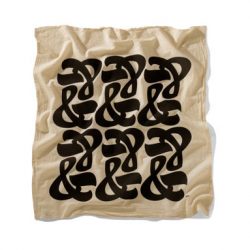
<p align="left"><em>Railsea</em> provides the most exemplary moment. The narrator, in a metafictional address to the reader, foregrounds the materiality of storytelling by addressing the novel’s most distinctive stylistic tic, the total replacement of the word <em>and</em> with ampersands. According to the narrator, the &#8220;&amp;&#8221; is a perfect ideogrammatic representation of the railsea itself — a conjunction that mirrors the track&#8217;s twists and turns to end almost adjacent to where it began. It is an elegant suturing of style and substance, a veritable fucking <em>point de capiton</em> in which the self-consciously disruptive signifier is sewed into the world-fabric of the novel, making the novel itself only another instance of the materiality of the fantastic.</p>
<p align="left">The novel, like all his others, works in an affective register different from what we expect from literature, especially the stuff tagged with a genre like &#8220;science fiction.&#8221; To approach them with the implicit hope, no matter how well disavowed, of achieving insight into human nature or of being <em>moved</em> along these lines, must result in absolute disappointment. But to approach these moments as fantastical materialists ourselves, to acknowledge the bankrupt allegorical structure in the face of the structuring automaton of genre and to ride its impersonal logic to its inevitable conclusion, is to open another affective field, one in which the joys of reading can be felt not as an exploration of interiority but in the structures and abstractions that constitute the world.</p>
<p><a href="http://thenewinquiry.com/publications/magazines/"><img title="subscribe-footer" src="http://thenewinquiry.com/wp-content/uploads/2012/09/subscribe-footer.png" alt="" width="383" height="80" /></a></p>
]]></content:encoded>
			<wfw:commentRss>http://thenewinquiry.com/essays/mievilles-anticlimaxes/feed/</wfw:commentRss>
		<slash:comments>0</slash:comments>
		</item>
		<item>
		<title>I Have No Mouth but I Must Scream</title>
		<link>http://thenewinquiry.com/essays/i-have-no-mouth-but-i-must-scream/</link>
		<comments>http://thenewinquiry.com/essays/i-have-no-mouth-but-i-must-scream/#comments</comments>
		<pubDate>Thu, 16 Feb 2012 16:24:41 +0000</pubDate>
		<dc:creator>Ben Gabriel</dc:creator>
		
		<guid isPermaLink="false">http://thenewinquiry.com/?post_type=essays&#038;p=4871</guid>
		<description><![CDATA[Hello Kitty is the international emblem of cute, which is among the most powerful forces capitalism has to marshal consumer troops for the system’s reproduction. Can she still be redeemed as an anticapitalist icon?]]></description>
			<content:encoded><![CDATA[<p><img class="alignnone size-full wp-image-5533" title="hellokitty-wireframe-x2" src="http://thenewinquiry.com/wp-content/uploads/2012/02/hellokitty-wireframe-x2.png" alt="" width="383" height="220" /></p>
<p>Why doesn&#8217;t Hello Kitty have a mouth? Is its absence more than an expedient, minimalist design choice? And does her lack of a mouth necessarily translate into the absence of a voice, as the arguments tend to go? The first Hello Kitty product, after all, was a coin purse with HELLO printed in block capitals over an image of Kitty; her name is her form, and it is speech.</p>
<p>Most political engagements with Hello Kitty have taken the mouthlessness issue as their impetus. They generally, through subversion or perversion, ironize Hello Kitty&#8217;s apparent inability to speak, suggesting her lack of expression is being upheld as a model, particularly for the young Asian girls who form Hello Kitty’s immediate target audience. A woman&#8217;s value, this particular feminine feline&#8217;s lack of mouth seems to say, is contingent on her voicelessness.<span id="more-4871"></span></p>
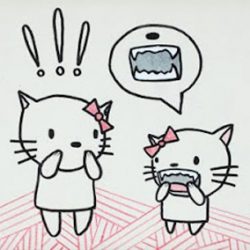
<p>Jason Han&#8217;s painting <em>I Haz Mouth,</em> commissioned for the Three Apples exhibition in 2009 on the occasion of Hello Kitty&#8217;s 35th birthday, whimsically addresses this issue. From the painting&#8217;s smirking LOLcats reference — LOLcats being a premier example of how giving a voice to the voiceless can be infantilizing rather than empowering — to the reiteration of the mouth in Kitty&#8217;s speech bubble, Han’s painting seems to invoke feminist and postcolonial concerns about lacking a voice only to wave them away. But <em>I Haz Mouth</em> functions not as a dismissal of the problem but an advancement. Looking past the irony of its title, we can see <em>I Haz Mouth</em> as an attempt to answer the question: If we gave Hello Kitty a mouth, what then?</p>
<p><img class="alignnone size-full wp-image-5532" title="essays_HELLOKITTY_jason-han" src="http://thenewinquiry.com/wp-content/uploads/2012/02/essays_HELLOKITTY_jason-han.jpg" alt="" width="383" height="284" /></p>
<p>Han has her answer not with words or language but with an image. Might Hello Kitty react to her induction into the regime of expression not as we might want her to — with a cathartic string of expletives — but by bypassing altogether the problems of language, opting instead to faithfully reproduce her newfound means of expression? Han&#8217;s painting suggests that Hello Kitty with a mouth would not merely speak imagistically, but that her speech itself would actually just serve to represent her mouth, like a guitar that no longer emitted notes but instead created guitars with each string plucked. Instead of entering the closed circuit of language, Kitty deploys the master signifier: the Word that is the Thing, the Logos. The gap between representing and represented is closed. </p>
<p>And because of the design minimalism that supposedly accounts for Hello Kitty&#8217;s lack of a mouth, something even stranger happens in Han&#8217;s painting: The speech bubble begins to look less like a representation of speech and more like a third, incomplete Kitty, with the triangle at the bottom serving as a potential ear. At a very basic level, then, the painting suggests that when Kitty is given the tools of language, she becomes capable only of uttering partial self-representations.</p>
<p>The weirdness of this is compounded by the fact that the mouthless Hello Kitty is actually more expressive. The “!!!” above her head signals something more concrete than the speech bubble with a mouth in it. The mouth &#8220;says&#8221; an image that refers to a specific, externally grounded discourse, one that&#8217;s technologically and historically marked and gendered and so on, whereas the lack of a mouth allows for the expression of direct astonishment, which is ambiguous and ultimately uninterpretable.</p>
<p>To read the “!!!” as envy, as though the mouthless Kitty has always wanted a mouth, must be backward, however. The painting suggests that in order to think to express a desire for a mouth, one must already have one — one must already be caught up in the order of language and have surrendered to its demands. Kitty can&#8217;t want a mouth until she&#8217;s got one — and when she does, it&#8217;s what she&#8217;s reduced to.</p>
<p style="text-align: center;">***</p>
<p>The claim that Hello Kitty&#8217;s lack of a mouth is problematic rests on the assumption that she operates principally as a representative object — as a sort of proxy for values or ideas like femininity, Asianness, or childhood — and that therefore  Hello Kitty&#8217;s depiction <em>performs</em> those things, reflecting and enacting the social norms that render women, children, or Asians speechless. Though this idea is widespread, it is a fundamental misrecognition of how Hello Kitty actually operates in people&#8217;s lives. It fails to account for the work she actually performs.</p>
<p>To illustrate this, it’s useful to compare Han&#8217;s painting with René Magritte&#8217;s <em>Les Deux Mystères</em> (“The Two Mysteries”). Both incorporate an independent work in order to capitalize on its disavowal (for Han, Hello Kitty, whose mouthlessness functions as a disavowal of speech; for Magritte, his earlier <em>Treachery of Images,</em> with its famous textual disavowal). And both problematize that disavowal (Han by doubling Kitty; Magritte by doubling the pipe).</p>
<p>The usual reading of <em>Treachery of Images</em> is that its joke turns on the disavowal that structures representation — its tagline is funny because it catches us in a natural slippage, and a necessary one in that it allows us to communicate at all. The realistically painted pipe is not a real, material pipe, but we refer to them in the same way, and we don&#8217;t notice the disjunction unless it is pointed out. We regard the painted pipe as a representative object even as Magritte tells us not to. Foucault suggested that the painted words “<em>ceci n&#8217;est pas une pipe</em>” refer not to the pipe above them but to themselves: The words are not “a pipe.”</p>
<p>With <em>Les Deux Mystères,</em> another layer of representation is added. It brackets the disavowal by moving it into a meta-space, making the disavowal a feature of the painting instead of its focus, which in turn enhances the ambiguity of the status of the new pipe. The additional pipe in <em>Les Deux Mystères</em> is untethered, both spatially and discursively. In <em>Les Deux Mystères</em> the large pipe could be on the wall or it could just as easily be floating in the foreground, the smaller of the two pipes. Or it could be a hazy apparition. With even less of a clear connection to the accompanying text, it can&#8217;t be said with certainty whether it is supposed to be a real pipe, another false representation, or just some sort of literal pipe dream — a dream of a pipe by the not-a-pipe on the easel.</p>
<p>This lack of clarity illustrates the logic of representation, which works by way of seeing-through — by viewers noticing primarily what is beyond what can be seen. For a representational reading of an image to apply, there must be a space between the thing as it appears and the thing as it is (in the broadest sense) “meant.” What is actually seen — on a canvas, say — therefore has to be disavowed on some level to properly understand why it appears there. This is why writing “<em>Ceci n&#8217;est pas une pipe</em>” under a painting of a pipe becomes a paradoxical call to immanence. By denying that the painted object is equivalent with what it represents, it forces viewers to focus on the paint instead of the object and therefore pay attention to what is inside and not what is beyond.</p>
<p><em>Les Deux Mystères</em> extends that call, suggesting that even when we see in terms of representation, we still primarily see the negative: to note, first and foremost, what isn&#8217;t there or what might exist behind what is. <em>Les Deux Mystères</em> registers and shows the differences, the kinds of gaps that the new elements create, and we ignore the particularities of the pipe in order to abstract it, to determine what it represents.</p>
<p>That is why a direct <em>détournement</em> of Hello Kitty along the lines of <em>Treachery of Images</em> — “This is not a Hello Kitty” — wouldn’t work. Even more savvy efforts (“This is not femininity” ) would only work contextually. Hello Kitty doesn&#8217;t function according to the logic of representation that Magritte lays bare. “I Haz Mouth,” as well as Hello Kitty in general, operates according to the logic of the icon. Instead of disavowal, what structures icons is immanence itself. Representing nothing, an icon yields fecundity in and of itself, offering itself up to instrumentalization.</p>
<p>This is why when Hello Kitty is introduced into the space of expression, as in Han&#8217;s painting, her radical refusal to submit to the logic of representation becomes important. Han&#8217;s mouthed Hello Kitty does not speak words, because putting a hole in her face doesn&#8217;t mean that suddenly there&#8217;s something behind; she stays as immanent as she ever was, only now with more lines, her symbolic content slightly altered but never really extended into that third dimension of representing.</p>
<p style="text-align: center;">***</p>
<p>In Angela S. Choi&#8217;s 2010 novel <em>Hello Kitty Must Die,</em> we see the possibilities and the problems of an interpretation of Hello Kitty that stays at the level of representation. The explicit critiques of Hello Kitty leveled by the novel’s narrator are fairly common: Hello Kitty is tied to stereotypes of Asian women primarily through her lack of a mouth. But in the novel, these critiques are juxtaposed with events that make them more problematic than they may first appear.</p>
<p>The novel follows Fiona Yu, a 28-year-old Chinese-American lawyer who still lives with her parents, as she navigates her dual heritage. Her struggles with tradition and expectation transform into a story of how she falls in asexual love with a serial killer and becomes something of one herself. Heavily indebted stylistically to Bret Easton Ellis’s <em>American Psycho</em> and early Chuck Palahniuk, Choi’s novel injects moments of shocking, grotesque, or otherwise surreal violence into a primarily realist frame to provoke audiences to register a limited social critique. But the particularities of Fiona&#8217;s murders allow Choi to at least gesture toward the possibility that sociopathy might stem from deeper social dynamics than poverty (or wealth).</p>
<p>Fiona&#8217;s excoriations over Hello Kitty&#8217;s mouthlessness highlight Choi’s concern with orality and power. When Fiona begins to murder, striking against the oppression of patriarchally privileged bosses and potential boyfriends, she does so in a distinctly oral way. From the roofies she carries everywhere to her scheme to fill her mouth with peanuts and kiss an overbearing loser with a nut allergy that her parents want her to marry, she makes the mouths of her victims into their weak point.</p>
<p>But that kiss never happens, and Fiona&#8217;s own mouth never provides her with power. The only moment when her own mouth is the focus comes at the end of the novel, through the ritual smoking of a cigarette. Only Fiona&#8217;s own metaphorical mouthlessness, her tendency to circumvent games of expression and instead attack their source, the mouths of others, puts her in a position to combat oppression. In other words, Fiona is rendered speechless by the dominant culture, and the only avenues of speech are through that culture&#8217;s narratives. Fiona&#8217;s story, though, is about weaponizing her speechlessness, receding from the regime of the mouth in order to wage war on it.</p>
<p style="text-align: center;">***</p>
<p>How can Hello Kitty and her popularity be used politically, if at all? Can it transcend the politics of <em>subversion</em> — a politics that necessarily cedes the ability to create narratives to those who already hold power, contenting itself with minor disruptions — to further instead a politics of <em>generativity</em>? One that, like Fiona Yu, does not seek to avoid its negation but actively weaponizes it.</p>
<p>These two politics do not make up a simple dichotomy, of course. They exist in a dialectical tension with each other, each fraying its counterpart as it reinforces it. To subvert a Hello Kitty, whether one simply subjects her image to appropriation as on <a href="http://www.kittyhell.com/" target="_blank">Hello Kitty Hell</a> or renders her &#8220;betrayal&#8221; more overtly elaborate by making her complicit with normalizing sexisms — as in the play <em>Hello (Sex) Kitty,</em> for instance — is to revel in the negation, make it ostensive, and therefore weaponize it. But these détournements never quite, on their own, follow through.</p>
<p>In the quest to ascribe to Hello Kitty political attitudes that can then be deconstructed, her utterly bizarre material existence is too easily forgotten. Stamped onto commodities to make them gifts or collectibles, Hello Kitty serves as the ghost of surplus value that haunts commodities. She is of course not bodied — a no body, an imprint, a bare form, often without even face to save. She is not just a cosmetic afterthought to baubles but a mold to shape them into. And she haunts the children of those maleficent forces who created her, knowing that they will exorcise her — not that she may be freed forever from a purgatorial hell but that she may dissipate into those children and order them to build her again, when they take control of the world, into a new and more powerful form. Hello Kitty&#8217;s objectivity is infinite precisely because her readiness to betray is infinite.</p>
<p>But here we can see one reason for the impotence of the politics of subversion. The assumption that Hello Kitty is representational misses the point. That&#8217;s not to say that these critiques and remixes don&#8217;t have any political purpose or even aren&#8217;t often wonderful pieces of art in themselves. But they work only within a limited sphere — and not in the sphere of political economy.</p>
<p>If Hello Kitty’s political efficacy is not to be limited by representationalism, we must consider a different definition of realism that doesn’t limit art’s usefulness to its degree of authenticity. In his debate with critic Georg Lukács, Bertolt Brecht defined what is “realistic” this way:</p>
<blockquote><p>Realistic means: discovering the causal complexes of society / unmasking the prevailing view of things as the view of those who are in power / writing from the standpoint of the class which offers the broadest solutions for the pressing difficulties in which human society is caught up / emphasizing the element of development / making possible the concrete, and making possible abstraction from it.</p></blockquote>
<p>Realism, that is, won’t be found through the intricacies of parlor-room introspection, as Lukács thought, nor in dirt and grit and Hobbesian cynicism as many believe today. It won’t be uncovered by plumbing the depths any more than by accurately representing the surface; it is only in the dialectical unity of the two that realist art can exist. Which is to say that realism is precisely the realm of the nonrepresentational image.</p>
<p>This may seem counterintuitive: Doesn’t it fly in the face of the reading of Magritte&#8217;s pipe? Surely the pipe and its disavowal work only because the paintings offer a realistic representation of a pipe. But such objections miss that the real is not merely the representational. To make realist art is not to simply mirror the world but to spray water on the web of social relations that holds the whole thing together. Realism is, at its core, a question of (un)masking what is real, which is to say that which structures reality.</p>
<p>Or, as Evan Calder Williams argues in a <a href="http://socialismandorbarbarism.blogspot.com/2009/04/on-laughter-and-realism-or-moral.html" target="_blank">post</a> about laughter and realism, “What we need now is a better sense of the real divide to be drawn, between the realism effect and affective realism, between what we&#8217;ve inherited as the &#8216;look&#8217; of realism and what actually nails down and pins, like a shaking butterfly of the present, the feel of our historical moment.” That is, a more politically effective realism doesn&#8217;t just look realistic, like Magritte&#8217;s pipe, but instead <em>feels</em> real, in ways beyond reflection or comprehension — it <em>feels</em> the way that living under the hegemony of finance capital does.</p>
<p>What Hello Kitty brings to the table in the contemporary search for this kind of Brechtian realism is a metonymic capacity to evoke the amorphous ideas that currently structure the social whole. The first and most obvious of these is globalization, as a result of Hello Kitty&#8217;s association with the Pacific Rim. Her geographical presence is a series of cleavages: between Japan (concretely) and London (narratively) but also with presence in China through counterfeiters, as well as California and Hawaii, which feature prominently in many of Hello Kitty product lines. Though Hello Kitty can seem fundamentally Japanese, she is not in the same way, say, that McDonald&#8217;s is American. More than a logo but less than a character, her fractured identity makes her more than a nation but less than truly international, just as globalization is always only a sufficient globalization of capital, not an even and total development. </p>
<p>Hello Kitty also serves as metonym for the process of consumer branding. Ken Belson and Brian Bremner&#8217;s 2003 book <em>Hello Kitty: The Remarkable Story of Sanrio and the Billion Dollar Feline Phenomenon,</em> relates how founder and CEO Tsuji Sanrio changed his company’s name to Sanrio from Yamanashi Silk Prefecture once he realized the power of branding: “If you attach added value or design to the product, they sell in a completely different way,&#8221; he said. In her metastasis, Hello Kitty now serves as an evocation of this mystery of how this value is added.</p>
<p>Mark Fisher&#8217;s essay “<a href="http://kubrickfilms.tripod.com/id92.html" target="_blank">SF Capital</a>” provides a short history of the use of branding in science fiction that helps clarify the interstitial space Hello Kitty occupies. Fisher contrasts <em>Star Wars</em> with earlier science-fiction, arguing that “what was bought and sold when audiences consumed <em>Star Wars</em> was not in any sense a single (aesthetic) object, but a world, a hypeverse.… <em>Star Wars</em> was designed as a hyper-commodity; not so much a film as a fictional system — a plane of consistency that could be populated with any number of commodities.” Later, with cultural products like <em>Transformers,</em> “what began to disappear was the sense of an original or primary entertainment &#8216;text&#8217;, surrounded or &#8216;supported&#8217; by secondary commodities, a disappearance that has been achieved almost completely now.”</p>
<p>Hello Kitty has always functioned in this way. Her “primary text” — the bits of biography and characterization that would explain and unify the imaginary universe she presumably occupies — are all very ancillary. Bits of trivia from her official bio on <em>Sanrio.com</em> — like how she lives in London and her real name is Kitty White — even when codified into a quasi-narrative system like the massively multiplayer game Hello Kitty Online or the show <em>Hello Kitty Paradise,</em> don&#8217;t solidify into coherence or sufficiency. Sanrio can continue to insist that Hello Kitty has certain values or comes from a certain place or does certain things, but without a mouth, it&#8217;s all just hearsay.</p>
<p>The actual primary text of Hello Kitty is the commodified junk on which she gets slapped to add value. And the traditional primary texts — films, TV series, books, etc. – become secondary. That&#8217;s because Kitty&#8217;s primary text is brand value itself. This transition from the primacy of narrative to the primacy of abstract value opens the possibility of thinking about the real structures of society not just according to their effects (on the individual or the collective) but also their affects: those impersonal forces which structure not just individual feelings but also impersonal feelings, like the “confidence” that moves markets.</p>
<p>Evan Calder Williams&#8217;s <a href="http://unemployedcinema.blogspot.com/2011/02/hostile-object-theory.html" target="_blank">hostile-object theory</a> offers a useful perspective here. He argues that:</p>
<blockquote><p>the objects of capitalism aren&#8217;t just indifferent to us or darkly coherent beyond our intentions. They are structurally hostile, and, more often than we&#8217;d like to admit, locally hostile: uncertain, unstable, loathing or loathsome, dangerous, and weirdly incommensurable with the purpose for which they were designed.</p></blockquote>
<p>That Hello Kitty might contain a seed of <em>structural</em> hostility — as opposed to the <em>individual</em> hostility of subjects under capitalism, euphemistically called “competition” — allows us to see not just how people are enmeshed in societal structures but also the nature of those structures themselves. Because a critique of Hello Kitty is, at its core, a critique of the affect of <em>cuteness</em>, not as a psychological but material condition, not as a feeling, but as a sign inscribed on the consuming body. Cuteness, with all its baggage of capriciousness, is probably the single most powerful force capitalism has to marshal consumer troops for the system’s reproduction.</p>
<p style="text-align: center;">***</p>
<p>The way that Hello Kitty works is no mystery. She is designed to provoke an affective reaction in a potential consumer, which transforms them into an active consumer. This happens because the affect with which she is associated, cuteness, is related to feelings of needing to possess and protect.</p>
<p>Graham Harman has argued in <em>Guerrilla Metaphysics: Phenomenology and the Carpentry of Things</em> that cuteness is a product of the fusion of mastery with sympathy for one who isn&#8217;t yet a master. But he misidentifies what is only an aspect of cuteness — its co-optation of something like <em>sprezzatura</em> — with cuteness as such. He claims adolescents use <em>cute</em> as a synonym for <em>lovely</em>, but <em>cute</em> is a differential term, distinct from <em>beautiful</em> or <em>hot</em>. If we were to put these three terms on a continuum of the attractive, <em>cute</em> would sit in the middle, between the girl who looks attractive and has obviously worked at it (<em>hot</em>) and the girl whose attractiveness seems effortless (<em>beautiful</em>). <em>Cute</em> denotes the beauty work that makes a show of effacing itself: the girl whose attractiveness appears as natural precisely because we know it has been worked on.</p>
<p>The much noted shift from an industrial to a postindustrial society, by way of neoliberalism and finance capital, has created an economy that relies heavily on managing affect. From the “confidence” of markets to the “friendliness” of service workers, all flows of capital have become infected with an affective component. Equally important, however, and less widely acknowledged, is the shift from productive to reproductive labor. When industry is organized around the model of finance, the point becomes not to produce but to continue the possibility of producing. Cuteness is the affect central to this.</p>
<p>Cuteness is, at its base, a form of work. Consider that the most “natural” and paradigmatic form of cuteness is a baby: not the baby as bawler and shit-machine but the baby as product of a labor that cannot be acknowledged as such except through mediation. The baby&#8217;s cuteness is its indivisible remainder, a thing that exists outside of it (all babies are cute, we know) but that it actualizes in its particularity in order to provoke the empathy and care necessary for its continued existence. Hello Kitty&#8217;s job, as both commodity and brand, is to objectify those conditions — to quite literally make an object out of these social relations and reify the mode of production through them. But commoditized cuteness, in stimulating emotional ties related to reproductive and affective labor (possessiveness, protectiveness, impulsiveness, happiness), holds the possibility of unveiling the ways in which they can work oppressively.</p>
<p>It is in this register that Hello Kitty&#8217;s secret strength comes to light, associated as she must be with those who cannot or do not make a productive contribution to the economy. Whether children or <em>hikikomori</em>, hoarding collectors, Japanese <em>kawaii</em> adherents who &#8220;refuse to grow up,&#8221; or whoever else, Hello Kitty is found everywhere that the current organization of capitalism is most fractured but where it seems to have reached its own boundaries.</p>
<p>Hello Kitty&#8217;s cuteness is thus a central hub of capitalism&#8217;s contemporary efforts to maintain itself. Cuteness wagers that its hiddenness constitutes its focus; a baby is cute, but only insofar as we refuse to acknowledge that what allows it to exist and continue existing is real labor. Hello Kitty&#8217;s material reality, too, though, is of importance here. She is not just an abstraction, an idealized cuteness; she is not even really a substantial character, that can exist beyond her instantiations. Hello Kitty is, at the level of the junk to which she is affixed, an attempt at an objective marker of a gift.</p>
<p>The gift under capitalism is the moment that circulation is affected by the introduction of an irreducible social aspect. As the gift of cuteness, then, Hello Kitty becomes a sort of value-analog that works by exempting itself from circuits of valorization. Sanrio&#8217;s motto — “Small Gift, Big Smile” — tacitly acknowledges this; a description of the object, the affect, and a silence for what comes after.</p>
<p>But what comes after is the important question. What can one do with this gift, this rubble?</p>
<p style="text-align: center;">***</p>
<p>Two passages from Belson and Bremner&#8217;s book about Sanrio indicate a few possible directions. The first is a quote from a Japanese cultural conservative, Osamu Nakano:</p>
<blockquote><p>In considering the personality traits of the new breed, the first characteristic we note is they are &#8216;moratorium people&#8217; — that is, they do not want to grow up. It is not that they cannot but that they do not even try. They repudiate the maturity demanded by the norms of adult society and prefer to remain kids — a dramatic contrast with the members of the previous generation, who became anxious to attain full-fledged adulthood, when they reached 20 or so. To be sure, the ability to remain kids presupposes the overprotection made possible by affluence, but it seems to me that the moratorium psychology also signifies repugnance toward the values underlying and created by modern society.”</p></blockquote>
<p>Nakano&#8217;s fear is precisely the fear that the afterlife of the gift ceases to be an after, that the exemption takes place before the circuits of exchange can be successfully completed. Whether this happens through will or inevitability, whether it is styled as protest or infantilization, these are the tools that we have been given to fight with, and so fight with them we must.</p>
<p>The final quote comes from the text itself and is the co-authors attempt to ironically note the feminist potential of Hello Kitty:</p>
<blockquote><p>Without quite knowing it, Japan has experienced the subtle emergence of a girl-power movement over the last several decades and Hello Kitty, at the symbolic level, is leading the way. Sure, Japanese men control the political and economic structures and all the trappings of power that come with that, but it is the young, unattached, urban working woman who enjoys the most personal freedom in this highly structured society. She floats from job to job, travels often and typically has the kind of disposable income to buy a Gucci handbag. Hello Kitty and cute or frivolous consumption are about feeling good and carefree. In that sense, Hello Kitty is a menace, a Bolshevik with a bomb, a threat to the established value system.</p></blockquote>
<p>This sort of feminism, of course, is nothing but the flipside of immiseration, shuffling new subjects into established power structures and leaving them unaffected, except superficially.  For the many being forced into more precarious and untenable situations, there are a few who carry the mask of freedoms that the commodity can impart to quiet the imagination. And therein lies Hello Kitty&#8217;s potential; she is no Bolshevik with a bomb, no outside agent attempting to revolutionize a system. She is the system, and she is the bomb within it.</p>
]]></content:encoded>
			<wfw:commentRss>http://thenewinquiry.com/essays/i-have-no-mouth-but-i-must-scream/feed/</wfw:commentRss>
		<slash:comments>0</slash:comments>
		</item>
		<item>
		<title>Toward a Reading of Post-Kanye Hip-Hop</title>
		<link>http://thenewinquiry.com/essays/toward-a-reading-of-post-kanye-hip-hop/</link>
		<comments>http://thenewinquiry.com/essays/toward-a-reading-of-post-kanye-hip-hop/#comments</comments>
		<pubDate>Thu, 29 Sep 2011 20:00:12 +0000</pubDate>
		<dc:creator>Ben Gabriel</dc:creator>
		
		<guid isPermaLink="false">http://thenewinquiry.com/?post_type=essays&#038;p=1819</guid>
		<description><![CDATA[The rise of swagger and the increasing irrelevance of haters The past decade has seen the meteoric rise of a new subject position in the hip-hop world: the swaggerer. Whether with underground lights like Lil B or more mainstream artists like Kanye West, you may have noticed a strange insistence on the authenticity of the]]></description>
			<content:encoded><![CDATA[<h2><a href="http://doctordude.tumblr.com/post/6209288061" target="_blank"><img src="http://media.tumblr.com/tumblr_lrf1jo5Vew1qzll1y.gif" alt="" width="400" height="224" /></a></h2>
<p><strong>The rise of swagger and the increasing irrelevance of haters</strong></p>
<p>The past decade has seen the meteoric rise of a new subject position in the hip-hop world: the swaggerer. Whether with underground lights like Lil B or more mainstream artists like Kanye West, you may have noticed a strange insistence on the authenticity of the artists’ swagger. The stock has reached such a point that Jay-Z’s opening line for the first single off the highly anticipated <em>Watch the Throne</em> collaboration with Kanye is simply: “I invented swag.”</p>
<p>Swagger is not new to hip-hop but has always been exterior to it. It recalls ’70s rockers, ’20s gangsters, pirates and Shakespearean vagabonds. The connotations are all, one might say, very white. But it is a very particular kind of whiteness — one which is very aware of itself and makes an explicit performance of its own economic or legal disenfranchisement. The particularity of swagger’s performance lies in its combination of material signifiers of wealth, particularly designer-brand clothing or jewelry, with bodily gestures or attitudes of defiance, as in the strut or the sneer. The coincidence of this performative particularity and historical connotation differentiates swagger from other, similar concepts (militancy, for instance, or hedonistic consumerism) and allows for its redeployment in new contexts.</p>
<p>Hip-hop’s appropriation of swagger, however, is fraught. If one of hip-hop’s most important myths — that its bootstraps/entrepreneurial possibilities — requires a believable performance of economic insufficiency to be convincing, then swagger gives the hip-hop lexicon an incredibly desirable tool. But because swagger’s whiteness must be incorporated into a black cultural form, it’s loaded with the potential for sabotage.</p>
<p>Kanye’s unparalleled success in instrumentalizing swagger has come precisely through his alertness to this danger. His aesthetic and public personae so successfully court and deny whiteness that the potential issues with swagger become negligible. By finally unlocking the potential of swagger, he has put himself in a position to fundamentally alter the genre’s episteme, ushering in a generation of rappers who (perhaps unconsciously) recognize the structural deficit in hip-hop he has articulated and attempt (also probably unconsciously) to rectify it. This is post-Kanye hip-hop.</p>
<p>—-</p>
<p>Hip-hop, like all genres, is a self-replicating system — something inhuman, like capital, corporations, or nations. A genre doesn’t function as a genre unless it establishes the conditions of its own replication. In other words, genre is more than the coordination of certain aesthetic points; it is the mill into which the grist of labor (of producers, consumers, aesthetics, and so on) is fed in order to generate more of itself.</p>
<p>To be recognizable as such, genres are always already structured by a regime of interpretation — a metanarrative: not any specific narrative but a means of verifying whether particular narratives fall within the genre’s purview. A metanarrative is clearest in the way certain interpretations are privileged. For example, the 1990s <em>Scream</em> trilogy ironized the horror film’s metanarrative, articulating the genre’s “rules” without displacing or canceling them.</p>
<p>Kanye has recast hip-hop’s metanarrative, changing the way we recognize what hip-hop is by forcing a rethinking of one of its fundamental antagonists: the hater. Tracks as early as the Notorious B.I.G.’s 1997 “Playa Haters” organized hip-hop around the contention between the player — the rapper’s persona — and the hater, an abstract individualized negativity constructed as a mirror of the player’s narcissism. By repudiating the hater, the rapper can validate himself. But for Kanye, the <em>hater</em> is not someone to be struggled against. Because of Kanye’s success in importing swagger, with its powerful capacity to perform disenfranchisement, the hater, who serves primarily as a hysterical critic of the authenticity of this kind of performance, is defanged. The hater need not be an effective antagonist to create value for the protagonist.</p>
<p>Instead of simply finding another nay-saying stereotype to do battle with to prove his authenticity, Kanye parades the haters’ defeat around, like Achilles desecrating Hector’s corpse. Kanye’s chosen method of desecration, though, is more like a perverse valorization: Because of his more or less complete inoculation on charges of whiteness or richness (thanks to a complex mixture of publicized statements, aesthetic innovations, and relations to the field of contemporary hip-hop), the haters’ attempt to attack his authenticity on those grounds not only fails but actually makes Kanye seem more authentic.</p>
<p>—-</p>
<p>The Yeezian view of the structure of hip-hop is one in which the productive antagonism between artist and hater has been supplanted by a more benign form of exploitation, typified by the “I &lt;3 Haters” meme. For Kanye, it means maintaining haters as a class of producers whose weapons are aimed at players to aggrandize his own swagger. Unlike the previous incarnations of haters — and not just “fuck the haters” but also “love your haters” or “haters are motivation,” all of which shared an orientation toward them — “I &lt;3 Haters” abjures the haters’ agency. Shifting the hater out of the antagonistic episteme without replacing him allows the pretense that hip-hip doesn’t require a structural antagonism. When “we’re all in this together,” well, being radicalized becomes a bit passé. What Kanye’s hip-hop does, then, is very different from proletarianization; it is, in fact, more analogous to a making middle class.</p>
<p>In a <a href="http://breakbeatbecoming.blogspot.com/2011/08/post-kanye-kanye-how-he-learned-to-stop_19.html" target="_blank">post about the libidinal economy of haters</a>, Nico Fulgencio wonders whether “taken in another context, couldn’t [Kanye’s I &lt;3 Haters] just as well be a sincere and almost Christ-like manner of speaking?” My immediate response is to say, no, and fuck Kanye.</p>
<p>Because Kanye’s “Christ-like” apologetics happen only after he has instrumentalized swagger and altered the internal structure of hip-hop, they are less like benevolent expressions among neighbors and more like contemporary forms of charity. What Nico so deftly analyzes in the troll-hater struggle — the haters’ production of schadenfreude is conditioned by trolls who use them to create fame value — turns out to be precisely what Kanye obviates: namely, that haters need to be trolled to become a source of value. <em>Post-Kanye</em> is precisely the absence of that need.</p>
<p>With Kanye’s intervention in hip-hop, the hater becomes little more than a useful ontological fact, a sort of natural resource with no epistemological weight. This can be seen most clearly in the artists who operate under the umbrella of influence his fame provides. Cher Lloyd’s “Swagger Jagger” offers a particularly good example. While her haters are undeniably real — as Nico notes, the official Youtube page for her song has overwhelmingly more “dislikes” than “likes” — she in no sense considers them serious opponents. They don’t even provide motivation; they simply exist, produce value unintentionally, are abstractly addressed. There isn’t any schadenfreude going on, because there simply aren’t two agents. Haters have been absolved of their agency, and one doesn’t go about taking pleasure in the pain of rocks.</p>
<p>The No Good Advice blog’s <a href="http://nogoodadviceblog.blogspot.com/2011/08/1-this-week-cher-lloyd-swagger-jagger.html" target="_blank">post</a> on “Swagger Jagger” falls into the same trap that Nico’s defense of Kanye does: It neglects the way the “difficult generational gap in U.S. hip-hop” plays out at the level of genre. This is particularly true when No Good Advice points up the similarities between Cher Lloyd and Mick Jagger to make a dig at “rockist authenticity.” The identification of rockists as a subgroup of haters is on point, but the failure to acknowledge the newly compromised condition of the hater makes that identification useless in understanding the song’s dynamics. If the critics Lloyd targets are so musically illiterate as to consider the song — whose musical roots are so obvious as to be almost physically painful in the “My Darling Clementine” chorus — “an irritating novelty,” then they aren’t people who could threaten her artistic credibility; they are people who overtly don’t give a damn about music. Haters no longer police the essence of a genre. The very composition of rockists as a class makes their criticism irrelevant.</p>
<p>The GZA line “First of all, whose your A&amp;R / A mountain climber who plays an electric guitar,” (from “Protect Ya Neck”) or the Jay-Z line “Industry shady it need to be taken over” (from “Izzo (H.O.V.A.)”) aren’t irrelevant, however. The music industry, like most industries, is still largely by and for straight white men, and it would be stupid to claim that it wasn’t. But conditions <em>have</em> changed. Twenty years later, that same A&amp;R rep is almost certainly listening to Gaga while climbing the rock wall at the gym, or smiling and tapping along when he hears Arcade Fire leaking out of his son’s room. Maybe he even turns on Rihanna’s S&amp;M to hide the sounds of the internet porn he’s watching when he’s masturbating while his kids are home. The point being that while rockist authenticity he may crave, he’s sure as fuck not going to let that stand in the way of his profit, and he knows as well as anyone else that deep down he might be a hater, but so what? And isn’t that, in a very real way, a good thing?</p>
<p>—-</p>
<p>This is where swagger as a sort of labor is necessary to understand this turn in hip-hop. At its very core, swagger is a strut, or a sneer; it is fabric hung from your frame just so, or stones and chains. It is a performative gesture, an etching of the body in the world. Following <a href="http://socialismandorbarbarism.blogspot.com/2010/07/roman-letter-4-on-rage-and-swagger.html" target="_blank">Evan Calder Williams</a>, it is a performance of a very particular kind of dispossession, an affective position that codes for no resolution and whose only outlet is a form of explosive violence. Swagger is, that is to say, both the schematization of Kanye’s hip-hop and the precondition of a riot. And swagger is precisely the performance of this disenfranchisement as if it could be otherwise, as if this position could produce, have effects.</p>
<p>To swagger is to perform — to make of one’s body a sign, an affective condition (which, to be clear, I mean in a sense much closer to “material conditions” than “one’s feelings”) — as though it could possibly be productive. To labor is always to perform: to transmute one’s body into labor-power, a productive process, the creation of consumer objects or services and surplus-value — as though labor itself were outside the regime of production. Both swagger and labor are, in the end, a mystification, a falsifying of origin. It is only the swagger jacker/jagger, or the scab, whose material demystification of this individualism brings about the proper return to real order of things.</p>
<p>To turn back, as I’m sure I will again and again, to Soulja Boy’s “hop up out the bed / turn my swag on / took a look in the mirror, said what’s up / yeah, I’m gettin’ money, oh;” it is precisely the garbling of language here, the accident of ambiguity that this lyrical construction creates, that points through the impasse of labor/swagger vs. rage/swagger. Is Soulja Boy here describing a situation in which he looks in the mirror, swag turned on, and gets money? Or one in which he looks in the mirror, swagged turned on, and says to himself, “I’m getting money?”</p>
<p>It absolutely does not matter. Soulja Boy is a figure who quite literally gets money by saying “get money.” There is no gap. To reach the point where the word and the thing are one and the same — or, more precisely, where there is no differentiation between performance and action — one must simply turn one’s swag on.</p>
<p><em>Ben Gabriel is an unemployed college graduate and sometime political activist. He blogs at <a href="http://uninterpretative.blogspot.com/" target="_blank">Uninterpretative</a>.</em></p>
]]></content:encoded>
			<wfw:commentRss>http://thenewinquiry.com/essays/toward-a-reading-of-post-kanye-hip-hop/feed/</wfw:commentRss>
		<slash:comments>0</slash:comments>
		</item>
	</channel>
</rss>