twitter
facebook twitter tumblr newsletter
blog-shines-like-174
Shines Like Gold
By imp kerr
what matter who's speaking?
rss feed

Triple-Decker Weekly

From the year 2003 and working backwards to the beginning of human history, we generated, according to IBM’s calculations, five exabytes–that’s five billion gigabytes–of information. By last year, we were cranking out that much data every two days. By next year, predicts Turek, we’ll be doing it every 10 minutes. […] It’s the latest example of technology outracing our capacity to use it. In this case, we haven’t begun to catch up with our ability to capture information, which is why a favorite trope of management pundits these days is that the future belongs to companies and governments that can make sense of all the data they’re collecting, preferably in real time. [Smithsonian]

Physicists store short movie in a cloud of gas.

A new anti Wi-Fi wallpaper, developed by french scientists, will go on sale in 2013.

This system is enriching patent trolls—companies that buy patents in order to extort money from innovators. These trolls are like a modern day mafia. […] The larger players can afford to buy patents to deter the trolls, but the smaller players—the innovative startups—can’t. Instead, they have to settle out of court. Patent trolls take advantage of this weakness. […] Clearly, the laws need revision. [Washington Post]

Over recent years a body of research has accumulated showing the psychological benefits of nostalgia. For example, reminiscing about the past can combat loneliness and off-set the discomfort of thinking about death. Now a team led by Xinyue Zhou has shown that nostalgia brings physical comforts too, making us feel warmer and increasing our tolerance to cold. [BPS]

Why identical twins differ—despite having the same DNA.

Mummies were stolen from Egyptian tombs, and skulls were taken from Irish burial sites. Gravediggers robbed and sold body parts. “The question was not, ‘Should you eat human flesh?’ but, ‘What sort of flesh should you eat?’ ” says Sugg. […] As science strode forward, however, cannibal remedies died out. [Smithsonian]

“Illusory Power Transference” is the academic name for feeling powerful due to a superficial connection to a powerful person, such as having once been in the same room. [OvercomingBias]

In a Dutch study performed by Pieter van Baal and colleagues, the authors compared the annual and lifetime health care costs of three cohorts, namely the obese, the smokers, and the healthy living people. […] The lifetime costs for an obese person amounted to € 399,000, compared to which the smoker comes at a 14% discount of € 341,000, but the healthy living person with a 17% premium at € 468,000. [Chronic Health]

New York City agency pushes plan to prevent cyberattacks on elevators, boilers. [Network World]

US Drone fleet can keep tabs on the movements of Americans, far from the battlefields. And it can hold data on them for 90 days — studying it to see if the people it accidentally spied upon are actually legitimate targets of domestic surveillance. [Wired ]

The ‘body clock’ or circadian rhythms controls things like alertness, sleep patterns, appetite and hormones, and travelling across time zones or working nights can disturb it. […] Not getting enough sleep puts you at increased risk of obesity, diabetes and related metabolic disorders. [Genome Engineering]

A new study suggests that, by disrupting your body’s normal rhythms, your alarm clock could be making you overweight. [Science]

The hypothesis was that people who used particular basic word orders would have more children: It turns out that speakers of SOV languages have more children than speakers of SVO languages. [Replicated Typo]

Small children (age 4-6) who were exposed to a large number of children’s books and films had a significantly stronger ability to read the mental and emotional states of other people. […] Psychologists have found that people who watch less TV are actually more accurate judges of life’s risks and rewards than those who subject themselves to the tales of crime, tragedy, and death that appear night after night on the ten o’clock news. [via OvercomingBias]

When you “lose yourself” inside the world of a fictional character while reading a story, you may actually end up changing your own behavior and thoughts to match that of the character, a new study suggests. [Ohio State University]

Anything, including liquid water, can be a touch-screen thanks to a new sensory system designed by a scientist from Disney Research. [TPM]

Understanding J.P. Morgan’s Loss, And Why More Might Be Coming.

We’ve been told by the New York Times, you know, the newswpaper of record, that Apple only paid a 9.8% tax rate last year. This really is the most gargantuan ignorance on their part. The $3.3 billion has nothing, nothing at all, to do with the $34.2 billion: something which any accountant at all could have told them. [Forbes]

Adscend Media agreed not to spam Facebook users and pay US$100,000 in court and attorney fees, according to the settlement. Adscend Media’s spamming generated up to $20 million a year. [IT World]

Brazil retailer using Facebook likes… on its clothing hangers.

Two years after Europe bailed Greece out to protect the euro, the rescue has become a debacle that threatens to unravel the common currency. […] Greece’s bailout by the EU and International Monetary Fund is the costliest financial rescue of a nation in history, with paid or pledged loans totaling €245 billion. It has already involved the biggest-ever sovereign-debt default, a debt restructuring that wiped out more than €100 billion of Greek bond debt. […] Greek premier George Papandreou says that when he asked German Chancellor Angela Merkel for gentler conditions in 2010, she replied that the aid program had to hurt. “We want to make sure nobody else will want this,” Ms. Merkel told him. [WSJ]

Spain is in a complete economic crisis. Its unemployment rate of 24.4 percent is higher than the U.S. unemployment rate during the worst of the Great Depression. And there’s no Spanish New Deal waiting around the corner to turn things around. The prolonged spell of mass unemployment is going to degrade workers’ abilities and prevent young people from gaining skills. The most capable and daring Spaniards will emigrate abroad, and Spanish firms will (rationally) fail to invest in improving the productivity of their workers. This bleak outlook will make investors more reluctant to loan euros to the Spanish government, which will then force more rounds of tax hikes and budget cuts, which will further crush the Spanish economy. A country that was booming a few years ago now looks doomed. But perhaps there is a way out, one suggested by the recent experience of Argentina, a nation that’s currently enjoying full employment. [Slate]

A first thing to say is that the dollar, like the United States, isn’t going anywhere. The United States still accounts for nearly a quarter of global GDP when the output of other countries is valued at market exchange rates (which is the appropriate metric when one is concerned with international transactions). By this measure, the United States is still nearly three times the economic size of both China and Japan. Its financial markets are deep and liquid. The market in U.S. Treasury bonds—the principal instrument that foreign central banks hold as reserves—is the single largest financial market in the world. The fact that there exists a huge volume of currency transactions involving dollars allows investors to buy them in substantial quantities without driving up their price and to sell them without driving that price down. In the competition with other currencies, in other words, the dollar enjoys the advantages of incumbency. [The American Interest]

For every $1 Google spends lobbying, Apple spends 10¢.

Apple auto-disables outdated versions of Flash Player in latest software update. The move appears to be welcomed by Adobe.

Employees are often required to cede the rights to their designs and inventions to their employers. But Twitter Inc. has recently upended that tradition by drafting a policy that will put control over how such patents are enforced into the hands of its engineers and employees. Come Lague, the chief executive of Zetta Research, which buys patents from failed start-ups and sells them to other companies, believes Twitter’s new policy could affect the value of its own patents. [WSJ]

Tel Aviv University research finds that smart phone users develop new concepts of privacy in public spaces. […] Smart phone users are 70 percent more likely than regular cellphone users to believe that their phones afford them a great deal of privacy, says Dr. Toch, who specializes in privacy and information systems. These users are more willing to reveal private issues in public spaces. They are also less concerned about bothering individuals who share those spaces, he says. [American Friends of TAU]

The future of media on mobile devices isn’t with applications but with the Web.

“Most people with a mental disorder are happy.”

Many Internet users are unaware of bufferbloat because it has been masked by faster computers and bigger pipes and because it sneaked up on us slowly over time. But here’s a test. Think back to your first broadband cable or DSL Internet connection, right after you finally got rid of dial-up. How much faster is your Internet connection today than it was back then?  Don’t think in terms of numbers but of subjective performance.  It’s not much faster at all, is it? That’s bufferbloat. [Cringely]

The fear of being laughed at (gelotophobia) was examined in its relations to concepts from positive psychology in Austria, China, and Switzerland. Gelotophobes described themselves with lower overall estimations of their lives. [ The International Journal for Humor Research]

In sports, on a game show, or just on the job, what causes people to choke when the stakes are high? A new study by researchers at the California Institute of Technology (Caltech) suggests that when there are high financial incentives to succeed, people can become so afraid of losing their potentially lucrative reward that their performance suffers. Previous research has shown that if you pay people too much, their performance actually declines. [Caltech]

Despite 28 years of research, there is still no vaccine that provides effective protection against HIV. […] The virus is the most diverse we know of. It mutates so rapidly that people might carry millions of different versions of it, just months after becoming infected. HIV’s constantly changing form makes it unlike any viral foe we have tried to thwart with a vaccine. […] On top of that, HIV targets immune cells, the very agents that are meant to kill it. And it can hide for years by shoving its DNA into that of its host, creating a long-term reservoir of potential infection. So, creating an HIV vaccine is like trying to fire a gun at millions of shielded, moving targets. Oh, and they can eat your bullets. [NERS/Discover]

Forget Hannibal Lecter. The movie portrayal of serial killers as deranged loners with unusually high IQs is dangerously wrong and can hinder investigations. According to the FBI, serial killers are much different in real life. […] The majority of serial killers are not reclusive, social misfits who live alone. They are not monsters and may not appear strange. Many serial killers hide in plain sight within their communities. Serial murderers often have families and homes, are gainfully employed, and appear to be normal members of the community. […] Contrary to popular belief, serial killers span all racial groups. The racial diversification of serial killers generally mirrors that of the overall U.S. population. […] Female serial killers do exist. […] Serial murders are not sexually-based. There are many other motivations for serial murders including anger, thrill, financial gain, and attention seeking. [Crime]

The documents state that Travolta said there was a Hollywood actress staying at the hotel that “wanted three way sex, and wanted to be double penetrated.” Travolta said they could have that later, but first they needed to have sex together before calling her, so this way they would be in-sync with each other sexually. [Radar]

Team-building exercises, simulation games, educational games, puzzle-solving activities, office parties, themed dress-down days, and colorful, aesthetically-stimulating workplaces are notable examples of this trend. […] This is a relatively new conception of the relation between work and play. Until very recently, play was seen as the antithesis of work. […] When employees are urged to reach out to their ‘inner child,’ it becomes clear that the distinction between work and play is increasingly difficult to maintain in practice. […] ‘Boredom’ might be an appropriate concept for rethinking the interconnections between work and play in present-day organizations. [ephemera]

If we look at how communication works we find that words and phrases have a great influence on attention. They bring into the consciousness of the listener the concepts that are uttered. This is what meaning is – the concepts that a word or phrase can steer attention towards. This is what communication is – the sharing of attention by two (or more) brains on a sequence of concepts. So it is not surprising that it is useful to talk to oneself. [Thoughts on thoughts]

A new Israeli law prohibits fashion media and advertising from using Photoshop or models who fall below the World Health Organization’s standard for malnutrition.

Sex addiction is big business, there is an American Society of Addictive Medicine that says addiction is a “chronic brain disorder” but this is unsupported by research. There are many clinics where the wealthy (males) can go to be cured. About 900 people have been certified as sex addiction therapists (CSAT) at a cost of about $5000. […] Chapter 13 is “The Ignored Aspects of Masculinity” where the sex addiction field focuses on men as intrinsically selfish, focused on “scoring” and virility. It ignores the part of men that are seeking love and trying their best to please their partners. [Electronic Journal of Human Sexuality]

Put aside your stereotypes about the sex industry and consider that many people, of all sexes and genders, can find the work empowering and healing. Wrenna Robertson is one such person, having worked for 18 years as a stripper. In this piece she talks about her own experiences as well as those of others, including escorts, porn actors, tantric practitioners and erotic masseurs. [The Scavenger]

I found it disturbing that women would only have these positive messages of empowerment, financial independence and a life of luxury to base their decision on entering this world. [New Left Project]

One of the most important things to remember when thinking about pitching is that there are huge numbers of pitches in the world. Venture capitalists hear quite a few of them. And they find the process frustrating because it is such a low yield activity (a tiny fraction of first pitches lead to subsequent diligence and even fewer of those lead to a deal). So if you want VCs to listen to you, you need to force them to listen—to break through the clutter. Doing so requires you to hack into the VC mind. […] You must address both sides of their brains; you have to convince VCs that your proposal is economically rational, and then you must exploit their reptilian brains by persuading their emotional selves into doing the deal and overcoming cognitive biases (like near-term focus) against the deal. [Blake Masters]

Milk contains enough calcium to turn nipples into bone – why do they remain soft?

Neurophysiological Explanation for the Perception of Poltergeists.

Chimp In Cocaine Study Starts Lying To Friends.

Shouldn’t the expression “head over heels” be “heels over head”?

David O’Reilly, The External World, 2010.

I had been living in Mexico City for only two months when I encountered artist P.J. Rountree’s collection of El Grafico covers.

Hard to tell where these people are from.

What part of NO don’t you understand?

█████████ did not believe █████████ actually █████████ in the manner █████████ described. The people who knew? Absolute bores. Motorneurons. Recyclers.

The book of shadows. They live in shadows. They are (dramatic music) The █████████ (and their morticians, and their assistants, and their perpetual faux-cool pauses, faux in-control pauses).
The faux.

█████████ compared the Judge’s Room to a shame. She compared the █████████ (20009-Present) and the method of █████████ to the Rocks, the Rockaways, the Wandering Rocks, mussels on the rocks, Kierkegaard, and the darkest pages of Flaubert’s correspondence. She amassed every moment, every impression, every absence, created a sort of history, and investigated this history, isolated (identified) the positions of dominance, and wrote a report where it was revealed that █████████ ‘s fabricated sensations, lapses of memory, inventions, and the words she never pronounced had been stored, amalgamated, and disgorged as smirks, hums, spells (hummed), laconic judgements, distastes (that would, in return, cause distaste), pause times, vexations, contumelies, and the cold calculation, perhaps repressed, of the uncertain advantages of “truth,” the distant perils such “truth” might prevent, the likelihood such “truth” would be misconstrued, mocked, inverted, debarred from acceptance, in order to, as a disorganization without enemies, a decentralized orchestration of moments, make this very last enemy renounce.

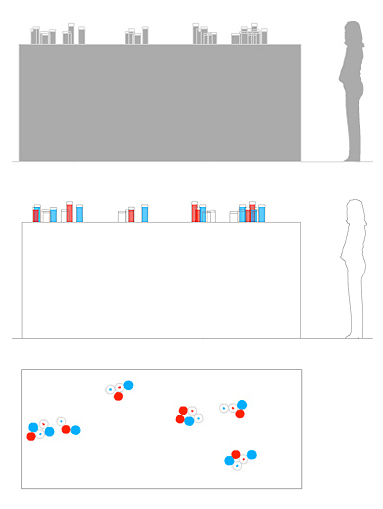
[Insert extremely clear diagram here.]

Crushed with violence was the one treated like an enemy, annihilated was truth. A renouncement represented by a letter in its actualization as another letter, for instance from a W to an M, a Z to a P, as in when and women and zilch and pestiferous, a larva, a blue lava, endlessly pupating and discharging, nothing else than a repetition, converted to the cause of her truth and the fact of her darkness, obdurate, destructive, malefic.

In a letter to █████████, published in Ecrits Posthumes, a book auto-da-féed in 2009, █████████ wrote, shouting her rage: The “power” that █████████ (plural) can get from █████████, I have never known a more powerless sorority of █████████ (plural). █████████ (singular) is lonely and sad, pale. I have challenged her and she sent █████████ to █████████ me but I didn’t even █████████. And yet she prevails.”

And as foretold, evil obtains more.

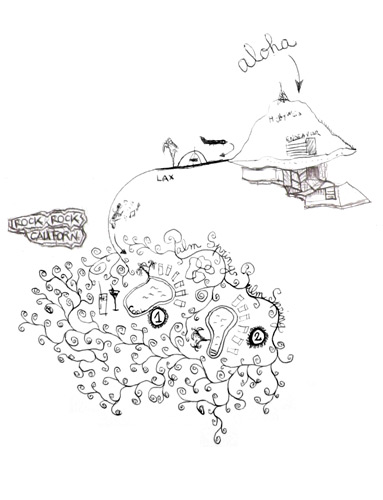
today we walked from 27th st to soho! it was so nice. this is the best weather, the best temperature… talked about hegel and the spurious infinite, talked about creativity and why it is drying up, and the convo veered off onto paranoia, schizophrenia and deleuze, i didn’t read the anti-oedipe so i was just listening… talked about goethe, itten and wittgenstein and color theories, picasso. talked about noise and aloha said there was that guy w/ a jackhammer outside her place going tatatata for over an hour yesterday afternoon and she was about to lose her mind. talked about the tapestry of noises, the omnipresence of the noises, our tolerance to noises, and truisms about noises, that we understand what calm is when we’re in the middle of the desert, in the middle of maine, in palm springs… smoked cigs. when we crossed greenwich village aloha got kind of blue, we walked by a place where she used to go with her ex. she’s not the kind of girl who mulls over the pros and cons for hours, procrastinates, holds things back, she just does things if her instinct kicks so, so she texted her ex, something like, hi! do you still have my mailbox key by any chance? xoxo a, and sibyl replied: oh crap! you’re totally right. i can drop it off. i don’t think i’m coming to manhattan this weekend but maybe next week? aloha read and said, what?! not even one x! she replied: i really don’t know why i still have feelings for you. and sibyl replied: this is why i get stressed when we start texting, it’s impossible to have a normal communication. have a good weekend. aloha turn her phone off and said, every time i try to open a door, she builds one more door — (hegel:) especially in the form of the quantitative progress to infinity which continually surmounts the limit it is powerless to remove. “i know, and such small portions.” i said, yeah. then we saw a weird car and talked about the time square bomber and aloha said she wanted to die. “it can go down to zero,” she said.

The voice is Ricky’s voice, but the hands are the hands of Ricky

All identities are only simulated, produced as an optical “effect” by the more profound game of difference and repetition.

i have a hard time with clients in vegas because my father lives there and knows 90% of the city. one of his best friends works for a group that owns one third of the strip so when i have a booking in vegas i have to make sure it doesn’t happen in one of those hotels. he thinks i’m a personal stylist. i’m supposed to travel across the country and advise rich men on how to dress. i hate lying but you get better as you get older. one client once told me that a big lie is the easiest defensive position. i never wanted to do anything like my father but it’s funny, that’s exactly what i’ve ended up doing.

i was born and raised in LA in a house in pasadena. to the zoo with my mom, fed the giraffes, the differences between asian and african elephants. my father was more likely to spend his time in poker rooms all over the country. but we (wut be) (my mom and i) didn’t know he was gambling.

my father was born with a trust fund as big as an art nouveau museum, and he told us he was touring the US to curate art exhibitions featuring the family’s paintings. while he was actually touring the country to get his poker fix. vegas, tunica, foxwoods. it was fargo. you lie until you go so deep that something too big for you happens.

funnily enough, he wasn’t a very good player. you might think good liars are good poker players, but no, good liars are self-destructive. paying debts was easy, he just had to sell paintings from the inheritance. that’s how my mom found out, when paintings started to disappear. one evening she turned the house upside down and found a notebook where all the poker debts were written down, a list of the paintings he sold, the money he burned, the names of the art dealers and auction houses. the sad part is that for years she thought he was having an affair. it killed her, not the lie itself, the waste of time. she died soon after figuring out he was “just” a poker player — actually a no-limit player who constantly loses. heart attack. 1999. i think she would have divorced him if she hadn’t died.

i stopped talking to my father. he sold the family home, moved to las vegas. i didn’t want any money from him. i got a job at a restaurant, waitress. i finally accepted to see him again, two years ago. clearly it took a lot of effort to swallow my anger. i’m still working on it. he’s one of those people who no matter how stupid and guilty they feel, never apologize. on the plus side they say “sorry.” reluctantly but they do. a “sorry” is nothing.

we’re slowly making up. he wasn’t who we thought he was, and i am not what he believes i am. we’re sort of even now.

“two cowboys.”
“american airlines.”

that’s my father’s favorite line. that was the only day he won big at a poker table. his opponent had two kings, he had two aces.

i took the train to york street and walked 3 blocks. on the way i saw cops keeping their guns trained on a trucker and searching his truck behind a screen of sawdust which floated in the air and expelled a smell of sawdust and drug in the street.

it was 2pm when i arrived at the studio, the elevator to the 5th floor, and the rusty, petrol blue dumbo door i pushed. there was a stuffed life size cheetah in the entryway LOL. a guy who was like the double of galliano and also the receptionist of the studio looked at me with a typical new york shitty grin, he was talking on the phone about what he ate for breakfast, and he was in the middle of a long continental list, but he paused and told me where to go. the studio was done with black shiny surfaces and mirrors, very disco, very want nasty pixxx? it looked like it hadn’t been touched since 1977 and the golden years. the photographer was 40 but looked 50. he went like ‘hey cutie!’ and introduced me to his assistant who was vacuuming a fake lawn, becky the hair/make-up girl, and two friends, ingrid and chiquita. they were listening to public enemy.

CHIQUITA: i kinda miss tapes.
PHOTOG: and the middle age, too?…
CHIQUITA: oh yeah, m, p, three. i know that.

becky brushed my hair out, they asked me to try on some black and pink lingerie, the photog briefed me. it’s for richardson, i want you to be like music, intelligible and inexplicable at the same time. totally me. i studied philosophy and read schopenhauer. i read hegel, i read kant, i read bergson. in my sophomore year i took a course on kant’s critique of pure reason. we were invited to focus on the ‘transcendental deduction of the categories,’ a big issue in kant’s philosophy, a major drag. i read heidegger, kant and the problem of metaphysics, i understood the problem, i bust kant — basically paraphrasing heidegger.

PHOTOG: let the strap fall down a little…

the fake lawn was itching dirty.

PHOTOG: ring the maid, pinch your nipple…

my back was attacked by the green spikes of the fake grass and i didn’t complain. i got a d minus and my professor said i was a ‘priggish pedant.’ i quit in the middle of the year. i was in love.

PHOTOG: pretend you’re a bouncer and you say no, no, no… i love that. i love the fingers. imagine you have a log on your back… and you bow your back… so it doesn’t fall…

do you want me to arch my back?…

PHOTOG: yes arch your back… get your butt a little higher… a tad… like if it was saying “fuck me now damn it!”

even when not smiling i was photographed. angling my knees, bandy. know the doggy style positions naked with my c-shaped tongue out of my mouth, he bought a new camera and tried it on various close up shots, a body without organs.

PHOTOG: you’re perfect… you’re karma-esque!

thanks.

12 rolls later i’m getting dressed.

CHIQUITA: i think you don’t know what pissing while getting fucked means.

INGRID: yes i know. it costs $1,500 extra.

CHIQUITA: last time i’m doing water sports with a boyfriend.

while the photographer is getting mad at his assistant, “yeah waste all the fucking gel so i can’t use it tomorrow…” starts to dance with little trips singing i always feel like somebody’s watching me, and drops his iphone on the floor, and breaks the screen.

PHOTOG: Ohmahgah!… this is not happening… fuck!… fuck!… to the apple store, right now…

CHIQUITA: i make a face like that when my steak falls into the pool.

we all left the studio so quickly. ingrid and chiquita took my phone number, we kissed goodbye and chiquita yelled “vida mundana!”

PHOTOG: i have 2 words for steve jobs and it’s not happy birthday.

on NY1 they said the cops found 80 pounds of ecstasy in powder in a truck in dumbo.

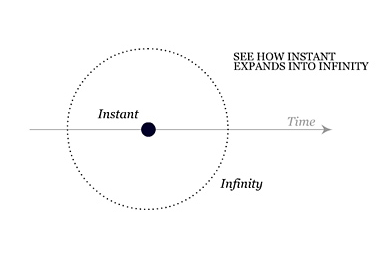
i asked aloha, how to wake up and feel the morning is over. she said there’s diana ross, touch me in the morning. i said it might turn me on, and i’m not going to ask kim to do any work. then she sent me a remarkable how to have vertigo and puke pic. piss your maniac hairdresser off. i have nothing to say about the jesus and mary chain album, hair are on the loose, the locks of hair before the wall, it’s a disorder unfolding in its own void, it will never end and you get a sense of that ‘never’ — id est, infinity in a moment.

Triple-Decker Weekly

Fortune Teller Used Google to Speak to the Dead.

Zoo Keeper Helps Constipated Monkey Pass Peanut By Licking Its Butt For An Hour.

The scientists individually told each member of another group of randomly selected people, “I hate to tell you this, but no one chose you as someone they wanted to work with.” […] The whole point of going through all of this as far as the students knew, was to sit in front of a bowl containing 35 mini chocolate-chip cookies and judge those cookies on taste, smell, and texture. The subjects learned they could eat as many as they wanted while filling out a form commonly used in corporate taste tests. The researchers left them alone with the cookies for 10 minutes. This was the actual experiment – measuring cookie consumption based on social acceptance. How many cookies would the wanted people eat, and how would their behavior differ from the unwanted? […] Why did the rejected group feel motivated to keep mushing cookies into their sad faces? […] The answer has to do with something psychologists now call ego depletion, and you would be surprised to learn how many things can cause it, how often you feel it, and how much in life depends on it. [You Are Not So Smart]

Research that I have done over the past decade suggests that a chemical messenger called oxytocin accounts for why some people give freely of themselves and others are coldhearted louts, why some people cheat and steal and others you can trust with your life, why some husbands are more faithful than others, and why women tend to be nicer and more generous than men. In our blood and in the brain, oxytocin appears to be the chemical elixir that creates bonds of trust not just in our intimate relationships but also in our business dealings, in politics and in society at large. Known primarily as a female reproductive hormone, oxytocin controls contractions during labor, which is where many women encounter it as Pitocin, the synthetic version that doctors inject in expectant mothers to induce delivery. Oxytocin is also responsible for the calm, focused attention that mothers lavish on their babies while breast-feeding. And it is abundant, too, on wedding nights (we hope) because it helps to create the warm glow that both women and men feel during sex, a massage or even a hug. Since 2001, my colleagues and I have conducted a number of experiments showing that when someone’s level of oxytocin goes up, he or she responds more generously and caringly, even with complete strangers. […] In our studies, we found that a small percentage of subjects never shared any money; analysis of their blood indicated that their oxytocin receptors were malfunctioning. [Paul J. Zak/WSJ]

When objects are arranged in an array from left to right, the central item calls out to you “Pick me, pick me!” […] In a new study psychologists have provided further evidence for what’s called the “Centre Stage effect” – our preferential bias towards items located in the middle. [BPS]

Sexual selection is a variant of natural selection in which one gender prefers certain traits be present in their mate. Thus individuals with those attractive traits will have a high reproductive success, spreading their genes (and the trait) through the population. This is the process which resulted in the large, elaborate tails of peacocks. Given the influence sexual selection can have on a population, researchers started to wonder if there were any traits in humans that were the product of mate-choice preferences. [EvoAnth]

The universal nature of human facial preferences suggests the possibility that such preferences are adaptations to the problem of mate choice. Sexual selection will have favored preferences for facial traits which are associated with reproductive success. […] One way facial traits may signal mate quality is by indicating the health of the individual displaying them. Healthy individuals confer a reduced risk of infection as well as the possibility of heritable immunity for their suitors’ offspring. Preferences for facial traits that are linked with health are therefore expected to be present. […] This study supports the finding that facial femininity and attractiveness may indicate women’s health history, which partially supports (although without confirmation of such relationships in future health, does not confirm) the hypothesis that female facial structure is a direct indicator of health functioning. [Evolutionary Psychology | PDF]

Jealousy and envy at work are different in men and women.

David Eagleman, neuroscientist: Take the vast, unconscious, automated processes that run under the hood of conscious awareness. We have discovered that the large majority of the brain’s activity takes place at this low level. The conscious part – the “me” that flickers to life when you wake up in the morning – is only a tiny bit of the operations. This understanding has given us a better understanding of the complex multiplicity that makes a person. A person is not a single entity of a single mind: a human is built of several parts, all of which compete to steer the ship of state. As a consequence, people are nuanced, complicated, contradictory. We act in ways that are sometimes difficult to detect by simple introspection. […] Raymond Tallis, former professor of geriatric medicine: [You] present us as more helpless, ignorant and zombie-like than is compatible with the kinds of lives we actually live and, what’s more, with doing brain science. [Guardian]

Efron observed the conversations of 1,250 Lithuanian and Polish Jews and 1,100 Italians from Naples and Sicily in and around New York City. Jews used a limited range of motion, mostly from the elbow. Their movements were more angular, jabbing, intricate, and vertical than those of the Italians, who used larger, smoother, more curved lateral gestures which pivoted from the shoulder. Jews tended to use one hand, Italians both. [Lapham's Quaterly]

Neuroscientists have uncovered the first evidence of a common genetic thread, which links together multiple senses in humans. The new findings suggest our sense of touch is genetically intertwined with our sense of hearing. [Cosmos]

Are straight people born that way? […] We have to start with a more fundamental question: What do we mean when we say someone is “straight”? At the most basic level, we seem to be imagining female bodies that are specifically sexually aroused by male bodies, and vice versa. Laboratory studies suggest that, while such people probably do exist — at least in North America, where many sexologists have focused their attentions – it’s not uncommon for straight-identified people to be at least a little aroused by the idea of same-sex relations. The media has tended to broadcast the news that gay-identified men and straight-identified men have quite discernible arousal patterns when they are shown various kinds of sexual stimuli. And that’s true. But if you look closely at the data, you’ll see that most straight-identified men do tend to show a little bit of arousal across sex categories (as do gay-identified men). [The Atlantic]

Drawing on the metaphor of ‘Prozac’, Prozac leadership encourages leaders to believe their own narratives that everything is going well and discourages followers from raising problems or admitting mistakes. Prozac is used to denote and symbolize a widespread social addiction to excessive positivity. Problems can occur, particularly if this positivity is seen to be discrepant with everyday experience. For example, if leaders repeatedly promise that ‘things can only get better’ but over time this does not happen, followers can become increasingly sceptical and cynical. This article warns that Prozac leadership, whether in corporate, political or other settings, can damage performance by eroding trust, communication, learning and preparedness. [SAGE]


Albert Tirrell and Mary Bickford had scandalized Boston for years, both individually and as a couple, registering, as one observer noted, “a rather high percentage of moral turpitude.” […] Choate kept that case in mind while plotting his defense of Tirrell, and considered an even more daring tactic: contending that Tirrell was a chronic sleepwalker. If he killed Mary Bickford, he did so in a somnambulistic trance and could not be held responsible. [Smithsonian]

Brain neuroimaging studies continue to outline the structural and functional abnormalities in disorders of mood. A relatively consistent finding has been a reduced volume of the brain hippocampus in major depressive disorder. […] The hippocampus is an important brain region to understand in the mood disorders. The hippocampus has a key role in memory. Patients with mood disorders commonly display impairments in mood including deficitis in autobiographical memory. Unipolar depression appears to increase risk for later development of Alzheimer’s disease. Hippocampal volume reduction is a common finding in Alzheimer’s disease. [Brain Posts]

A sense of the constraints faced by surgeons, and the mettle required of patients, in the era before anesthesia and antisepsis. [New England Journal of Medicine]

After a busy week with short nights, many use the weekend to make up for lost hours of sleep. Not a healthy habit, says researcher Paulien Barf. On the long run it could result into the development of obesity or even diabetes. Previous studies have shown that sleeping to recover from sleep shortage is of importance for a variety of physiological processes. [United Academics]

Well-meaning friends and family members may suggest that you have a couple of drinks after living through a stressful event. A friend of mine had a bike accident recently that sent her over a car door and miraculously left her with only a few bruises. Having a couple of drinks immediately after this will of course dull her nerves, since ethanol is an anxiolytic. But is it really a good idea to get tipsy (or worse) after living through a stressful event? Given that alcohol is an anxiolytic and that it causes amnesia, it doesn’t seem such a stretch to think that having a beer right after very a stressful event (within the next, say, 6 hours) will decrease the likelihood of long-term negative consequences (say, developing a phobia of biking). [xcorr]

Recent years has seen the emergence of a popular ‘raw food’ movement. Dehydrating food to make it palatable, raw-foodies argue that cooking food destroys valuable vitamins and enzymes, rendering it nutritionally impoverished. It sounds logical, but – especially with vegetables – is often false. Many vegetables actually gain nutritional value after careful cooking or steaming. Furthermore, a strict vegan raw food diet is not good for long term health. […] Red meat is notable in that it contains a good source of B-vitamins that are essential for healthy muscles, skin and nerves. It also contains iron and other important minerals. Like most things however, steak should be in moderation as a high intake is associated with colon cancer and other health nasties. […] The longer steak is cooked, the fewer vitamins it contains. [Doctor Stu]

The first perspective produces legislative atrocities like the proposed New York City bill that would have penalized taxi drivers for transporting prostitutes. […] I’m in favor of legalizing all forms of sex work for adults—not because I think it’s necessarily such great work, but because I think being a legal worker is better than being an illegal worker. [Jacobin]

All our ancestors lived in the continent of Africa until 150,000 years ago. Some time after that, say the genes, one group of Africans somehow became so good at exploiting their environment that they (we) expanded across all of Africa and began to spill out of the continent into Asia and Europe, invading new ecological niches and driving their competitors extinct. There is plenty of dispute about what gave these people such an advantage—language, some other form of mental ingenuity, or the collective knowledge that comes from exchange and specialization—but there is also disagreement about when the exodus began. […] Sea levels were 150 feet lower then, because the cold had locked up so much moisture in northern ice-caps, so not only were most Indonesian islands linked by land, but the Persian Gulf was dry and, crucially, the southern end of the Red Sea was a narrow strait. [WSJ]

From what I previously understood, people would ingest mushrooms, and if they were in a negative state of mind, they’d have a “bad trip.” […] I just figured that magic mushrooms must hyper-activate the parts of the brain that perceive color and sound, to the point where people perceive things that aren’t even there. However, recent research out of the U.K. says that, surprisingly, I’ve got it all backwards. […] The thought behind this finding is that when people do shrooms, pathways in the brain that would normally restrict cognition are temporarily turned off, allowing people to cognate at higher levels than ever before. [Try Nerdy]

In 1927, Gestalt psychologist Bluma Zeigarnik noticed a funny thing: waiters in a Vienna restaurant could only remember orders that were in progress. As soon as the order was sent out and complete, they seemed to wipe it from memory. Zeigarnik then did what any good psychologist would: she went back to the lab and designed a study. A group of adults and children was given anywhere between 18 and 22 tasks to perform (both physical ones, like making clay figures, and mental ones, like solving puzzles)—only, half of those tasks were interrupted so that they couldn’t be completed. At the end, the subjects remembered the interrupted tasks far better than the completed ones—over two times better, in fact. […] Your mind wants to finish. [Maria Konnikova/Scientific American]

Exercise, done right, has been found to reduce the risk of dying from any cause by at least one third with a 9% reduction for every one hour of vigorous exercise performed per week. To be fair, studies which calculate such risks are inherently flawed. […] That’s why I like to look at the exercise-health correlation using fitness as the marker. Because fitness is a direct consequence of exercise, and it is something we can objectively measure in the lab. A fit 45 years old man has only one quarter the lifetime risk of dying from cardiovascular causes compared to his unfit peer. And 20 years later, at the age of 65, being fit means having only half the risk of an unfit 65-year old. […] The association of fitness with cancer is not as well researched as with cardiovascular disease. But the available data clearly point to a substantial effect. [Chronic Health]

Cockroaches are actually highly social creatures. Cockroaches do not like to be left alone, and suffer ill health when they are. [BBC]

A single-celled organism in Norway has been called “mankind’s furthest relative.” The organism, a type of protozoan, was found by researchers in a lake near Oslo. They found it doesn’t genetically fit into any of the previously discovered kingdoms of life. It’s an organism with membrane-bound internal structures, called a eukaryote, but genetically it isn’t an animal, plant, fungi, algae or protist (the five main groups of eukaryotes). [LiveScience]

Not only is it accurate enough to compensate for the tiny aberrations in the optics, but it’s so accurate that we don’t know how accurate it is because we don’t yet have instruments accurate enough to measure the level of its accuracy. The point is it’s pretty accurate. [Gizmodo]

The internet is no stranger to crime. From counterfeit and stolen products, to illegal drugs, stolen identities and weapons, nearly anything can be purchased online with a few clicks of the mouse. The online black market not only can be accessed by anyone with an Internet connection, but the whole process of ordering illicit goods and services is alarmingly easy and anonymous, with multiple marketplaces to buy or sell anything you want. In our scenario we are going to legally transfer $1,000 USD out of a regular bank account and into a mathematical system of binary codes, and then enter a neighborhood of the Internet largely used by criminals. This hidden world anyone lets purchase bulk downloads of stolen credit cards, as well as a credit card writer, blank cards, some “on stage” fake identities—and maybe even a grenade launcher they’ve had their eyes on. A journey into the darker side of the Internet starts with two open-source programs: Bitcoin and the Tor Bundle. [CSO]

A group of computer security researchers have refined an innovative method of combatting identity theft. […] Its method, described in the journal Information Sciences, “continuously verifies users according to characteristics of their interaction with the mouse.” The idea of user verification through mouse monitoring is not new. As the researchers note, “a major threat to organizations is identity thefts that are committed by internal users who belong to the organization.” [Pacific Standard]

To justify its sky-high valuation, Facebook will have to increase its profit per user at rates that seem unlikely, even by the most generous predictions. […] The company is set to profit from selling user data but the users whose data is being traded do not get paid at all. That seems unfair. […] Why not  pay individuals for their data? […] If buyers choose only the cheapest data, the sample will be biased in favour of those who price their data cheaply. And if buyers pay everyone the highest price, they will be overpaying. [The Physics arXiv Blog]

The buy, driven entirely by Zuckerberg, was made because Facebook’s CEO was petrified of Instagram becoming a Twitter-owned property. [VentureBeat]

Google’s harvesting of e-mails, passwords and other sensitive personal information from unsuspecting households in the United States and around the world was neither a mistake nor the work of a rogue engineer, as the company long maintained, but a program that supervisors knew about, according to new details from the full text of a regulatory report. [NY Times]

Face recognition techniques usually come with a certain amount of controversy. A new application, however, is unlikely to trigger any privacy concerns because all of the subjects are long dead. Before photography took over, oil painting and portraiture was used to record what important people looked like. As a result for every artistically important painting there are a lot of “instant snaps” that fill museums and art gallery vaults. What would make these paintings much more valuable is knowing who all of the people in the portraits are. The solution might be to apply face recognition software. [I Programmer | UCR]

For eight days running, YouTube’s front page had been taken over by “botted” videos—videos whose views had been artificially inflated by software programs designed to trick YouTube’s servers—and as far as YouTubers could tell, YouTube’s owner, the mighty Google, seemed powerless to stop them. Google did eventually stop the worst of the bots, fixing a vulnerability in how the site counts mobile views. But the botting problem is far from over. And the episode leaves a lot of lingering questions over the site’s future. [DailyDot]

In 2009, the United States crossed a digital Rubicon: For the first time, the amount of data sent with mobile devices exceeded the sum of transmitted voice data. […] Placing a voice call, compared to streaming The Hangover 2 on Netflix or uploading a video clip of your friend’s latest freestyle BMX trick to YouTube, consumes virtually no bandwidth. […] And our calls are getting shorter. [The Wilson quaterly]

According to the Center for Responsive Politics, Apple spent $2.3 million on lobbying last year and its lobbying expenditures have been steadily increasing over the past decade – in 2000, it only spent $360,000 on lobbying. A big chunk of this is spent lobbying specifically on tax policy, especially repatriation legislation, which lets firms bring profits held overseas back to the United States at a cheaper tax rate. One bill in particular, the Freedom to Invest Act of 2011, would save companies like Apple, Google, and Cisco $78.7 billion, paid for by the American people. [Republic Report]

Why Verizon Doesn’t Want You to Buy an iPhone.

How awesome is this treasure trove of emails, documents, files placed online by the NY Fed? Some of the emails between Lehman execs are laughable — naive, silly, hubristic, childish. But my favorite piece simply has to be the Morgan Stanley research report from June 30, 2008 “Overweight Rating” on Lehman Brothers — “Bruised, Not Broken, Poised for Profitability.” 60 days later, Lehman Brothers filed what was then the largest bankruptcy in the United States. [Ritholtz]

How much is a recipe worth? About $1.8 million, according to the owner of Kay Lee Roast Meat Joint, who boosted the sale price of her Singapore eatery by that amount when she put it on the market this year. [Bloomberg]

The Black Death was one of the most devastating pandemics in human history, peaking in Europe between 1348 and 1350, and is estimated to have killed 30–60 percent of Europe’s population, reducing world population from an estimated 450 million to between 350 and 375 million in the 14th century. [Wikipedia]

These persecutions were the burning of Jews between 1348 and 1351, when in anticipation of, or shortly after, outbreaks of plague Jews were accused of poisoning food, wells and streams, tortured into confessions, rounded up in city squares or their synagogues, and exterminated en masse. [Oxford Journals]

How persistent are cultural traits? This paper uses data on anti-Semitism in Germany and finds continuity at the local level over more than half a millennium. When the Black Death hit Europe in 1348-50, killing between one third and one half of the population, its cause was unknown. Many contemporaries blamed the Jews. Cities all over Germany witnessed mass killings of their Jewish population. At the same time, numerous Jewish communities were spared. We use plague pogroms as an indicator for medieval anti-Semitism. Pogroms during the Black Death are a strong and robust predictor of violence against Jews in the 1920s, and of votes for the Nazi Party. In addition, cities that saw medieval anti-Semitic violence also had higher deportation rates for Jews after 1933, were more likely to see synagogues damaged or destroyed in the ‘Night of Broken Glass’ in 1938, and their inhabitants wrote more anti-Jewish letters to the editor of the Nazi newspaper Der Stürmer. [SSRN]

I read somewhere — and the person who wrote this was not a mountaineer but a sailor — that the sea’s only gifts are harsh blows and, occasionally, the chance to feel strong. [Primo Levi]

For decades, a small group of scientific dissenters has been trying to shoot holes in the prevailing science of climate change, offering one reason after another why the outlook simply must be wrong. Over time, nearly every one of their arguments has been knocked down by accumulating evidence, and polls say 97 percent of working climate scientists now see global warming as a serious risk. Yet in recent years, the climate change skeptics have seized on one last argument that cannot be so readily dismissed. Their theory is that clouds will save us. [NY Times]

From the diver who finds the body parts, to the forensic specialist who identifies flecks of paint on the victim and the handwriting expert who examines the killer’s notes. What happens at a crime scene?

Valuing art through its theft.

It is the only instance in the history of naval warfare where one submarine intentionally sank another while both were submerged.

The bear famously tranquilized on the University of Colorado campus last week, and immortalized in a viral photo by CU student Andy Duann, met a tragic death early Thursday morning in the southbound lanes of U.S. 36. [DailyCamera]

Michel Foucault with hair.

Mary E. Frey, Real Life Dramas, 1984-87.

Thomas Demand, Junior Suite [Whitney Houston's last supper], 2012 [DesignBoom | NY Times]

List of silent musical compositions.

Before entering the club, everyone had to sign a waiver, acknowledging that they were “at peace” with being fucked to death by Dr. Alexander Criscofist.

Nipples at the Met.

Bee, Join me, Welcome baby.

the infinite zoom in

“The conjunction ‘and’ in Flaubert does not at all serve the purpose that is assigned to it by grammar. It marks a pause in the rhythmic pace and divides a picture. Wherever we would use ‘and,’ Flaubert leaves it out.” –Marcel Proust, Regarding Flaubert’s “style”, 1919

“La conjonction ‘et’ n’a nullement dans Flaubert l’objet que la grammaire lui assigne. Elle marque une pause dans une mesure rythmique et divise un tableau. En effet partout où on mettrait ‘et’, Flaubert le supprime.” –Marcel Proust, À propos du “style” de Flaubert, 1919